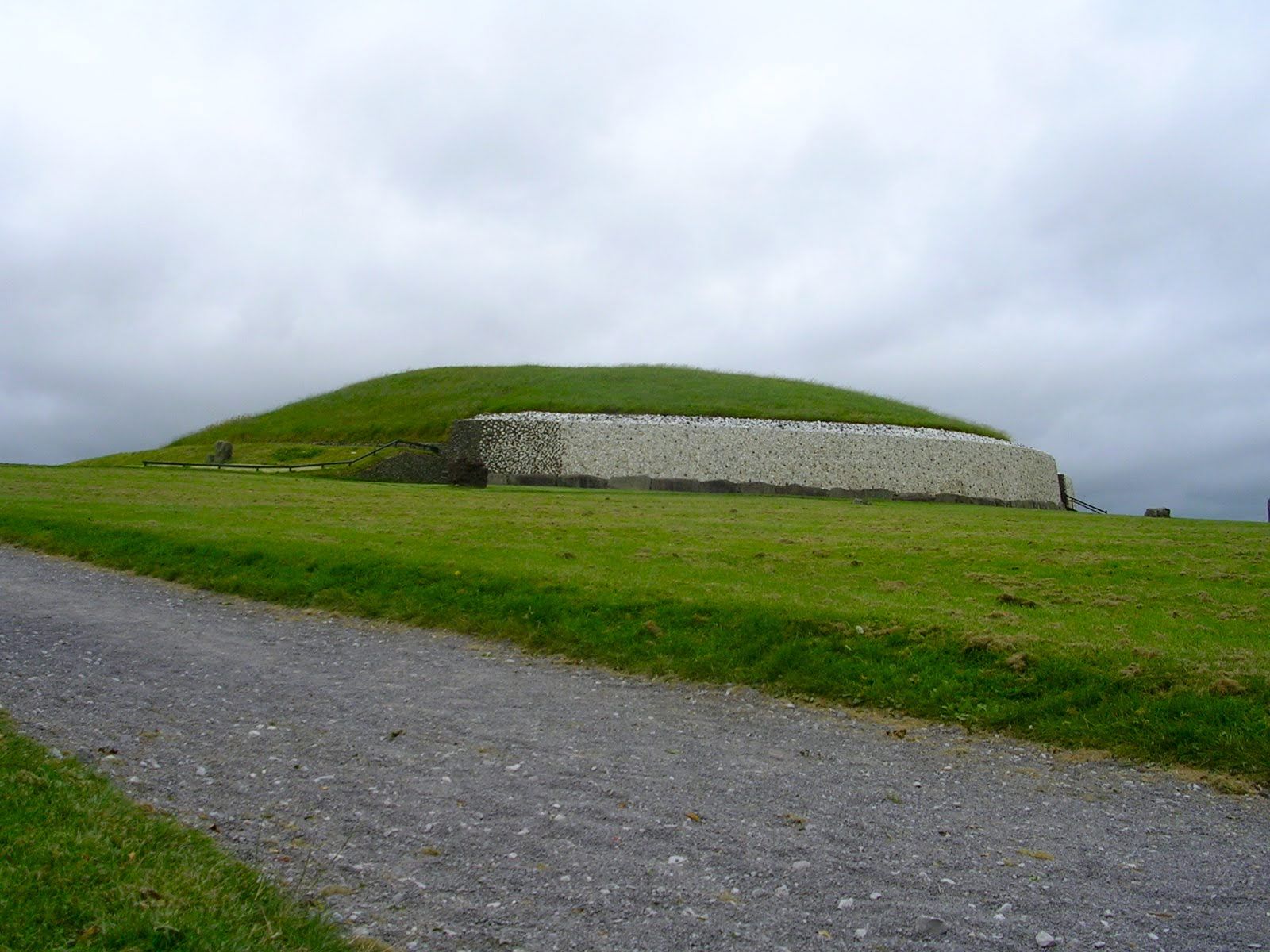
Brú na Bóinne - Archaeological Ensemble of the Bend of the Boyne (UNESCO 659)
Cultural World Heritage in Ireland, inscribed in 1993
Bounded on the south by a bend in the River Boyne, the prehistoric site of Brú na Bóinne is dominated by the three great burial mounds of Knowth, Newgrange and Dowth. Surrounded by about forty satellite passage graves, they constitute a funerary landscape recognised as having great ritual significance, subsequently attracting later monuments of the Iron Age, early Christian and medieval periods. Located about 40 km north of Dublin on a ridge between the rivers Boyne and Mattock, within several kilometres of other prehistoric mounds, the site is part of an area rich in stories of Ireland’s ancient past. Predominantly agricultural at the present time the area has been extensively explored for more than a hundred years by archaeologists and historians, with excavations revealing many features.
The Knowth group, where the earliest features date from the Neolithic period and the latest from the Anglo-Norman period, has produced thirty monuments and sites that figure on the official inventory; these include passage graves adorned with petroglyphs, enclosures, occupation sites and field systems. The Newgrange group is purely prehistoric, with a ringfort, cursus, passage graves and a henge. The Dowth group is similar to that at Newgrange but there is medieval evidence in the form of a church and a castle.
The Committee inscribed the site under criteria (i), (iii) and (iv) and invited the Irish authorities to control carefully future developments in and around the site and to involve ICOMOS in conservation and management planning.