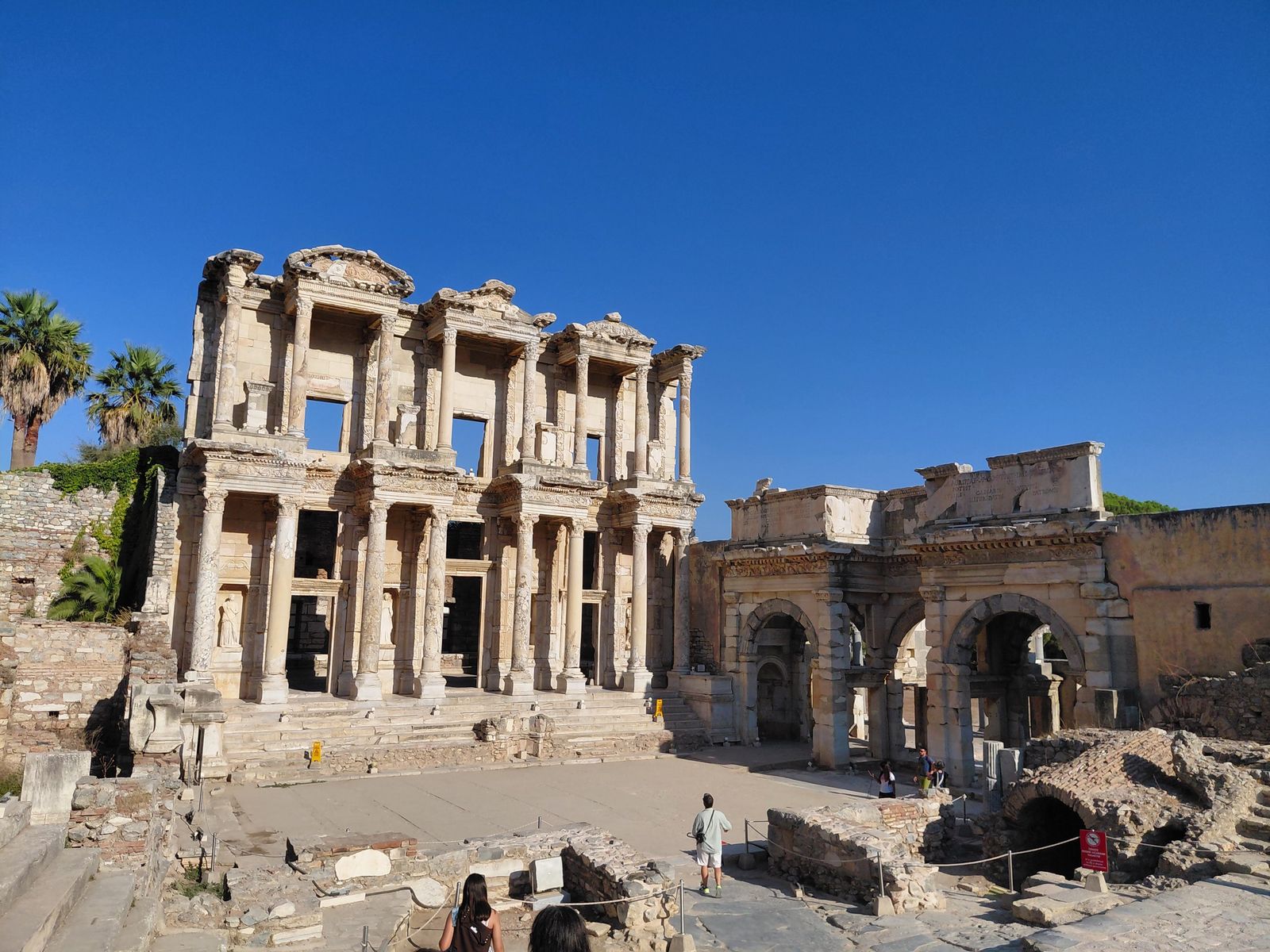
Ephesus (UNESCO 1018)
Cultural World Heritage in Türkiye, inscribed in 2015
Within what was once the estuary of the river Kaystros, a continuous and complex settlement history can be traced in Ephesus beginning from the seventh millennium BCE at Cukurici Mound until the present at Selçuk. Favourably located geographically, it was subject to continuous shifting of the shore line from east to west due to sedimentation, which led to several relocations of the city site and its harbours. The Neolithic settlement of Cukurici Mound marking the southern edge of the former estuary is now well inland, and was abandoned prior to settlement on the Ayasuluk Hill from the Middle Bronze Age. Founded by the 2nd millennium BCE, the sanctuary of the Ephesian Artemis, originally an Anatolian mother goddess, became one of the largest and most powerful sanctuaries of the ancient world.
The Ionian cities that grew up in the wake of the Ionian migrations joined in a confederacy under the leadership of Ephesus. In the fourth century BCE, Lysimachos, one of the twelve generals of Alexander the Great, founded the new city of Ephesus, while leaving the old city around the Artemision. When Asia Minor was incorporated into the Roman Empire in 133 BCE, Ephesus was designated as the capital of the new province Asia. Excavations and conservation over the past 150 years have revealed grand monuments of the Roman Imperial period lining the old processional way through the ancient city including the Library of Celsus and terrace houses.
Little remains of the famous Temple of Artemis, one of the ‘seven wonders of the world’ which drew pilgrims from all around the Mediterranean until it was eclipsed by Christian pilgrimage to the Church of Mary and the Basilica of St. John in the 5th century CE. Pilgrimage to Ephesus outlasted the city and continues today. The Mosque of Isa Bey and the medieval settlement on Ayasuluk Hill mark the advent of the Selçuk and Ottoman Turks.