Heart of Neolithic Orkney (UNESCO 514)
Cultural World Heritage in United Kingdom of Great Britain and Northern Ireland, inscribed in 1999
The Orkney Islands lie 15km north of the coast of Scotland. The monuments are in two areas, some 6.6 km apart on the island of Mainland, the largest in the archipelago. The group of monuments that make up the Heart of Neolithic Orkney consists of a remarkably well-preserved settlement, a large chambered tomb, and two stone circles with surrounding henges, together with a number of associated burial and ceremonial sites. The group constitutes a major relict cultural landscape graphically depicting life five thousand years ago in this remote archipelago.
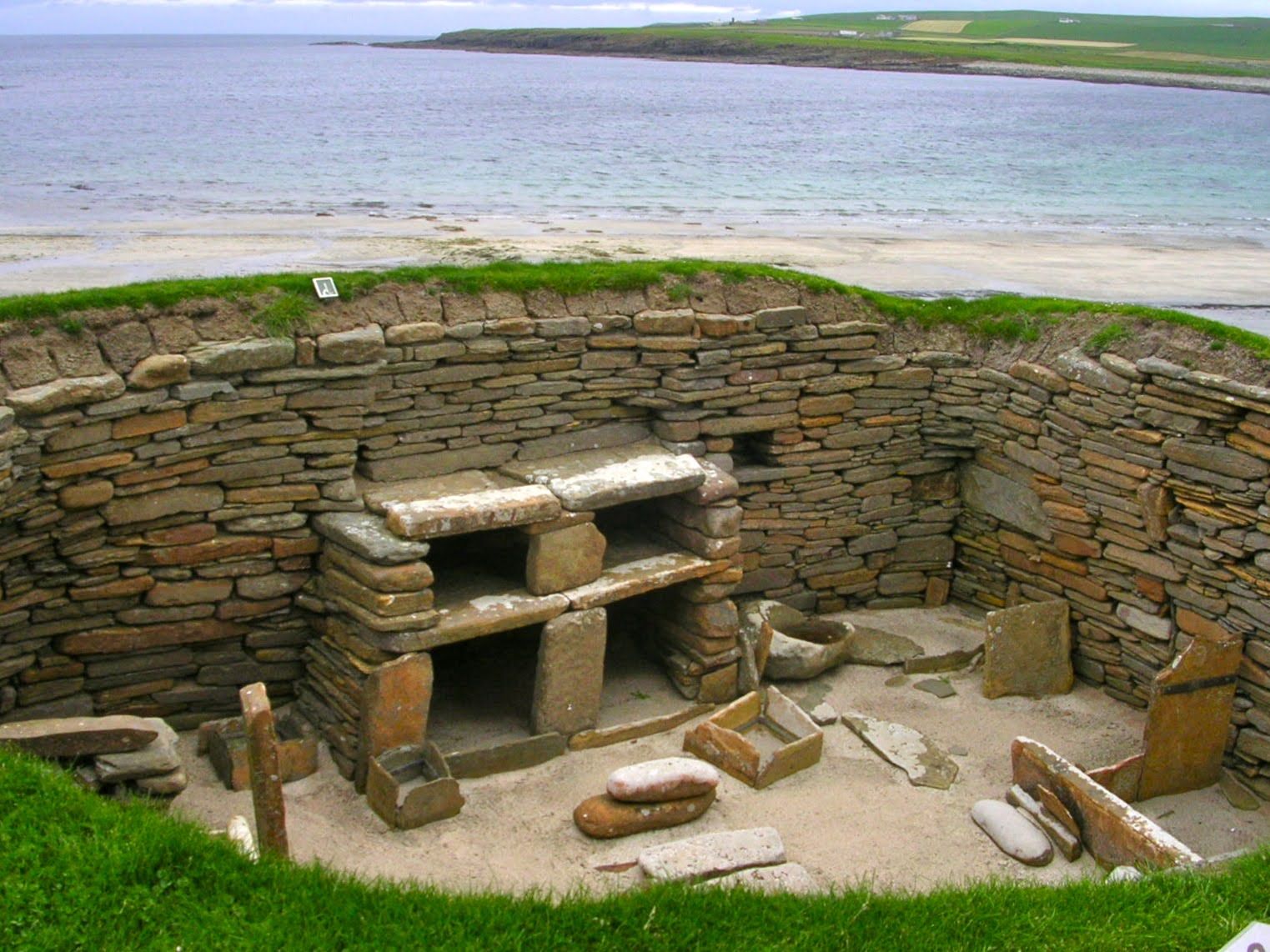
The four monuments that make up the Heart of Neolithic Orkney are unquestionably among the most important Neolithic sites in Western Europe. These are the Ring of Brodgar, Stones of Stenness, Maeshowe and Skara Brae. They provide exceptional evidence of the material and spiritual standards as well as the beliefs and social structures of this dynamic period of prehistory. The four main monuments, consisting of the four substantial surviving standing stones of the elliptical Stones of Stenness and the surrounding ditch and bank of the henge, the thirty-six surviving stones of the circular Ring of Brodgar with the thirteen Neolithic and Bronze Age mounds that are found around it and the stone setting known as the Comet Stone, the large stone chambered tomb of Maeshowe, whose passage points close to midwinter sunset, and the sophisticated settlement of Skara Brae with its stone built houses connected by narrow roofed passages, together with the Barnhouse Stone and the Watch Stone, serve as a paradigm of the megalithic culture of north-western Europe that is unparalleled.
The property is characteristic of the farming culture prevalent from before 4000 BC in northwest Europe. It provides exceptional evidence of, and demonstrates with exceptional completeness, the domestic, ceremonial, and burial practices of a now vanished 5000-year-old culture and illustrates the material standards, social structures and ways of life of this dynamic period of prehistory, which gave rise to Avebury and Stonehenge (England), Bend of the Boyne (Ireland) and Carnac (France). The monuments on the Brodgar and Stenness peninsulas were deliberately situated within a vast topographic bowl formed by a series of visually interconnected ridgelines stretching from Hoy to Greeny Hill and back. They are also visually linked to other contemporary and later monuments around the lochs.
They thus form a fundamental part of a wider, highly complex archaeological landscape, which stretches over much of Orkney. The current, open and comparatively undeveloped landscape around the monuments allows an understanding of the apparently formal connections between the monuments and their natural settings. The wealth of contemporary burial and occupation sites in the buffer zone constitute an exceptional relict cultural landscape that supports the value of the main sites.
Criteria (i), (ii), (iii), and (iv): The monuments of Orkney, dating back to 3000-2000 BC, are outstanding testimony to the cultural achievements of the Neolithic peoples of northern Europe.