Historic Centre of Mexico City and Xochimilco (UNESCO 412)
Cultural World Heritage in Mexico, inscribed in 1987
The Aztecs built what was to become the capital of their empire on a small island in the Lake of Texcoco, in the Valley of Mexico. Testimonies from the time of the arrival of the Spanish conquerors at Tenochtitlan, the capital of the Aztec Empire, account for the existence of the great lake dotted with a multitude of canoes and the island city, full of oratories like towers and fortresses and all gleaming white. The conquering Spaniards destroyed the island city of Tenochtitlan and started to drain the lake that surrounded it. They built the capital of New Spain, Mexico City, the “city of palaces”, on the ruins of the prehispanic city, following a European model which was slightly changed by the intervention of indigenous artisans and workers, and influenced by the canals and rivers that had structured the Pre-Hispanic city.
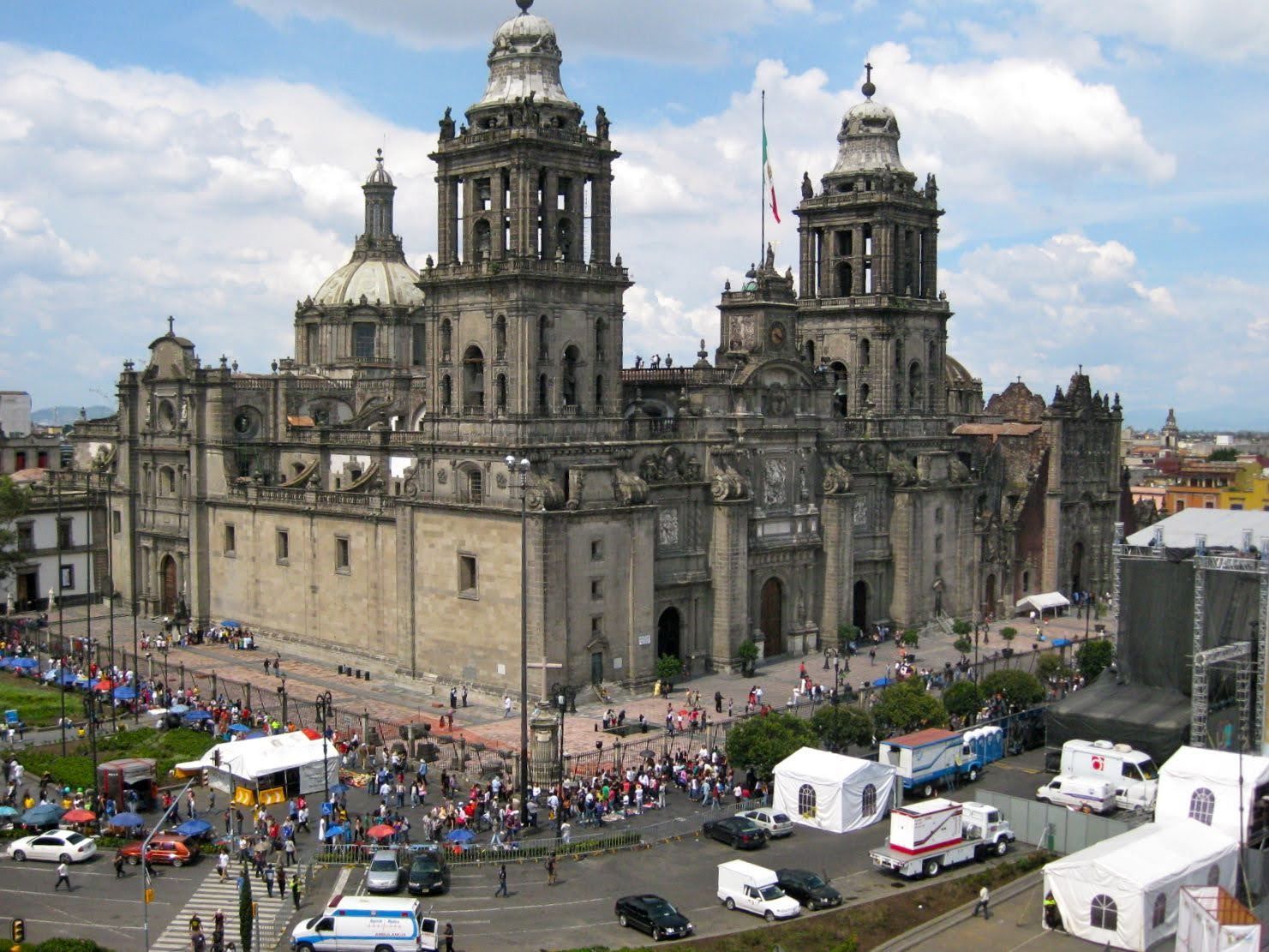
Independent Mexico maintained its capital on the same place and added its stylistic influences to the architectonic palimpsest that we are left with today. From the 14th to the 19th century, Tenochtitlan, and subsequently, Mexico City, exerted a decisive influence on the development of architecture, the monumental arts and the use of space first in the Aztec Empire and later in New Spain. The monumental complex of the Templo Mayor (Main Temple) bears exceptional witness to the cults of an extinct civilization, whereas the cathedral and the Palace of Fine Arts are examples of colonial and late 19th century architecture. The capital of New Spain, characterized by its chequerboard layout, the regular spacing of its plazas and streets, and the splendour of its religious architecture is a prime example of Spanish settlements in the New World.
The monuments, groups of buildings or sites located at the heart of the contemporary urban agglomeration amply illustrate the origins and growth of this city that has dominated the region for many centuries. The lacustrine landscape of Xochimilco, located 28 km south of the city, constitutes the only reminder of traditional Pre-Hispanic land-use in the lagoons of the Mexico City basin. In the midst of a network of small canals, on the edge of the residual lake of Xochimilco (the southern arm of the great drained lake of Texcoco), some chinampas or ‘floating’ gardens can still be found. Parts of this half-natural, half-artificial landscape are now an 'ecological reserve'.