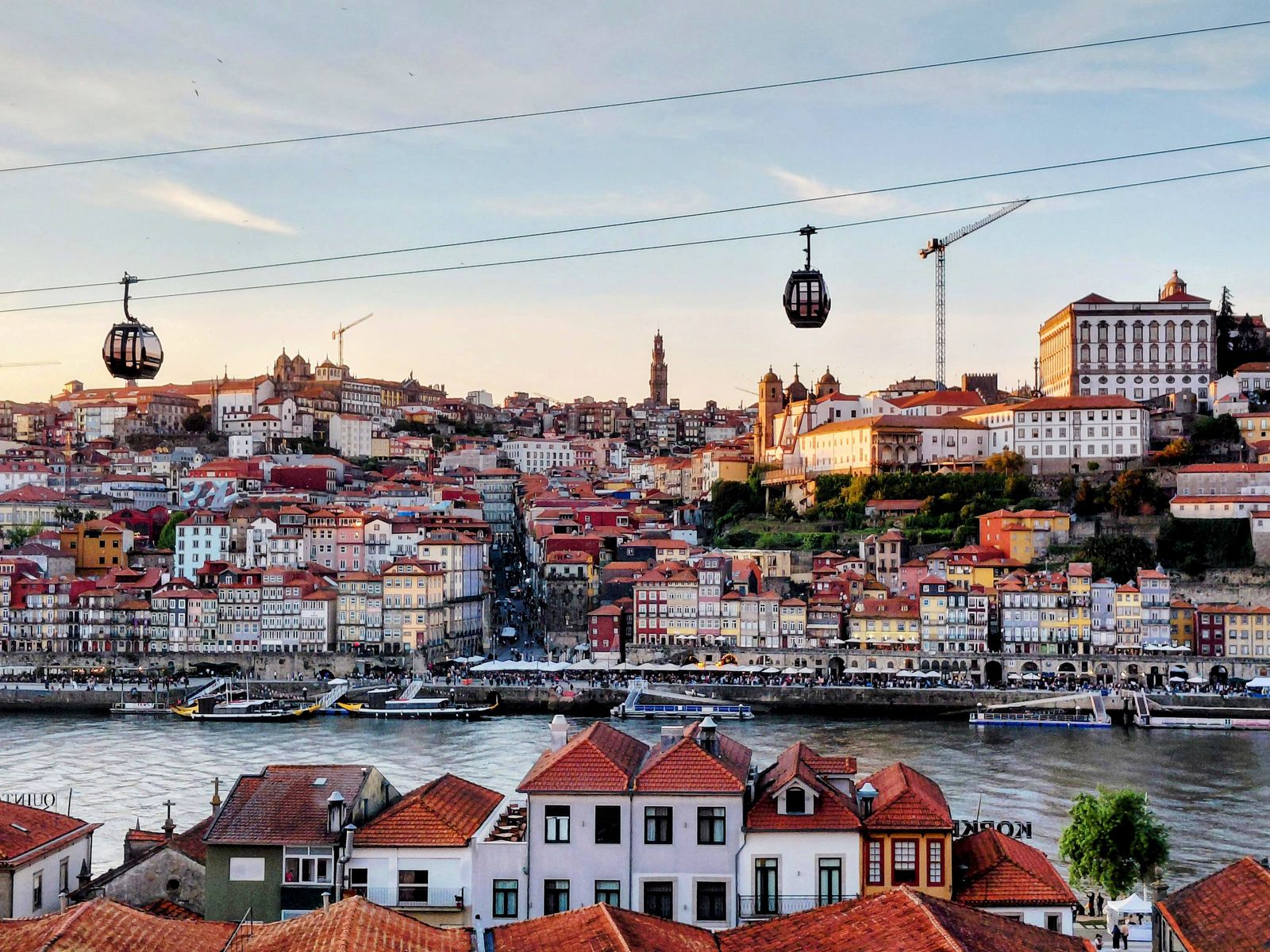
Historic Centre of Oporto, Luiz I Bridge and Monastery of Serra do Pilar (UNESCO 755)
Cultural World Heritage in Portugal, inscribed in 1996
The Historic Centre of Oporto, Luiz I Bridge and Monastery of Serra do Pilar, built along the hills overlooking the mouth of the Douro River in northern Portugal, is an outstanding urban landscape with a 2,000-year history. The Romans gave it the name Portus, or port, in the 1st century BC. Military, commercial, agricultural, and demographic interests came together in this place. Its continuous growth linked to the sea can be seen in its many and varied monuments, from the cathedral with its Romanesque choir to the neoclassical Stock Exchange and the typically Portuguese Manueline-style Church of Santa Clara.
The urban fabric of the Historic Centre of Oporto and its many historic buildings bear remarkable testimony to the development over the past thousand years of a European city that looks outward to the sea for its cultural and commercial links. Archaeological excavations have revealed human occupation at the mouth of the Douro River since the 8th century BC, when there was a Phoenician trading settlement there. By the 5th century the town had become a very important administrative and trading centre. In the succeeding centuries it was subjected to attacks and pillage by successive groups, including Swabians, Visigoths, Normans, and Moors.
By the early 11th century, however, it was firmly established as part of the Castilian realm. Expansion came in the 14th century with the construction of massive stone town walls to protect its two urban nuclei: the original medieval town and the hitherto extramural harbour area. The Historic Centre of Oporto is located within the line of these Fernandine walls (named after Dom Fernando, in whose reign they were completed in 1376), together with some smaller areas that retain their medieval characteristics. This area conserves to a large extent Oporto’s medieval town plan and urban fabric, along with some later monumental insertions as well as the two remaining sections of the Fernandine walls.
In this area are many important ecclesiastical buildings such as the cathedral – whose Romanesque core dates to the 12th century – and fine churches in various styles. The historic centre also has a number of outstanding public buildings, including the São João theatre (1796-1798; 1911-1918) and the former prison “Cadeia da Relação” (1765-1796). Among the important later structures are Palácio da Bolsa (1842-1910) and São Bento railway station (1900-1916). This rich and varied architecture eloquently expresses the cultural values of succeeding periods – Romanesque, Gothic, Renaissance, Baroque, neoclassical, and modern.
The active social and institutional tissue of the town ensures its survival as a living historic centre. This property also includes Luíz I Bridge and Monastery of Serra do Pilar.
The Committee decided to inscribe the nominated property on the basis of cultural criterion (iv) considering that the site is of outstanding universal value as the urban fabric and its many historic buildings bear remarkable testimony to the development over the past thousand years of a European city that looks outward to the west for its cultural and commercial links.