Historic Centre of Prague (UNESCO 616)
Cultural World Heritage in Czechia, inscribed in 1992
The inscribed site is a serial property comprising the Historic Centre of Prague situated on the territory of the self-governing administrative unit of the City of Prague, and of the Průhonice Park, located southeast of the city on the territory of the Central Bohemia. Prague is one of the most beautiful cities in Europe in terms of its setting on both banks of the Vltava River, its townscape of burgher houses and palaces punctuated by towers, and its individual buildings. The historic centre represents a supreme manifestation of Medieval urbanism (the New Town of Emperor Charles IV built as the New Jerusalem). It has been saved from any large-scale urban renewal or massive demolitions and thus preserves its overall configuration, pattern and spatial composition.
The Prague architectural works of the Gothic Period (14th and 15th centuries), of the High Baroque of the 1st half of the 18th century and of the rising modernism after the year 1900, influenced the development of Central European, perhaps even all European, architecture. The historic centre also represents one of the most prominent world centres of creative life in the field of urbanism and architecture across generations, human mentality and beliefs. In the course of the 1100 years of its existence, Prague’s development can be documented in the architectural expression of many historical periods and their styles. The city is rich in outstanding monuments from all periods of its history.
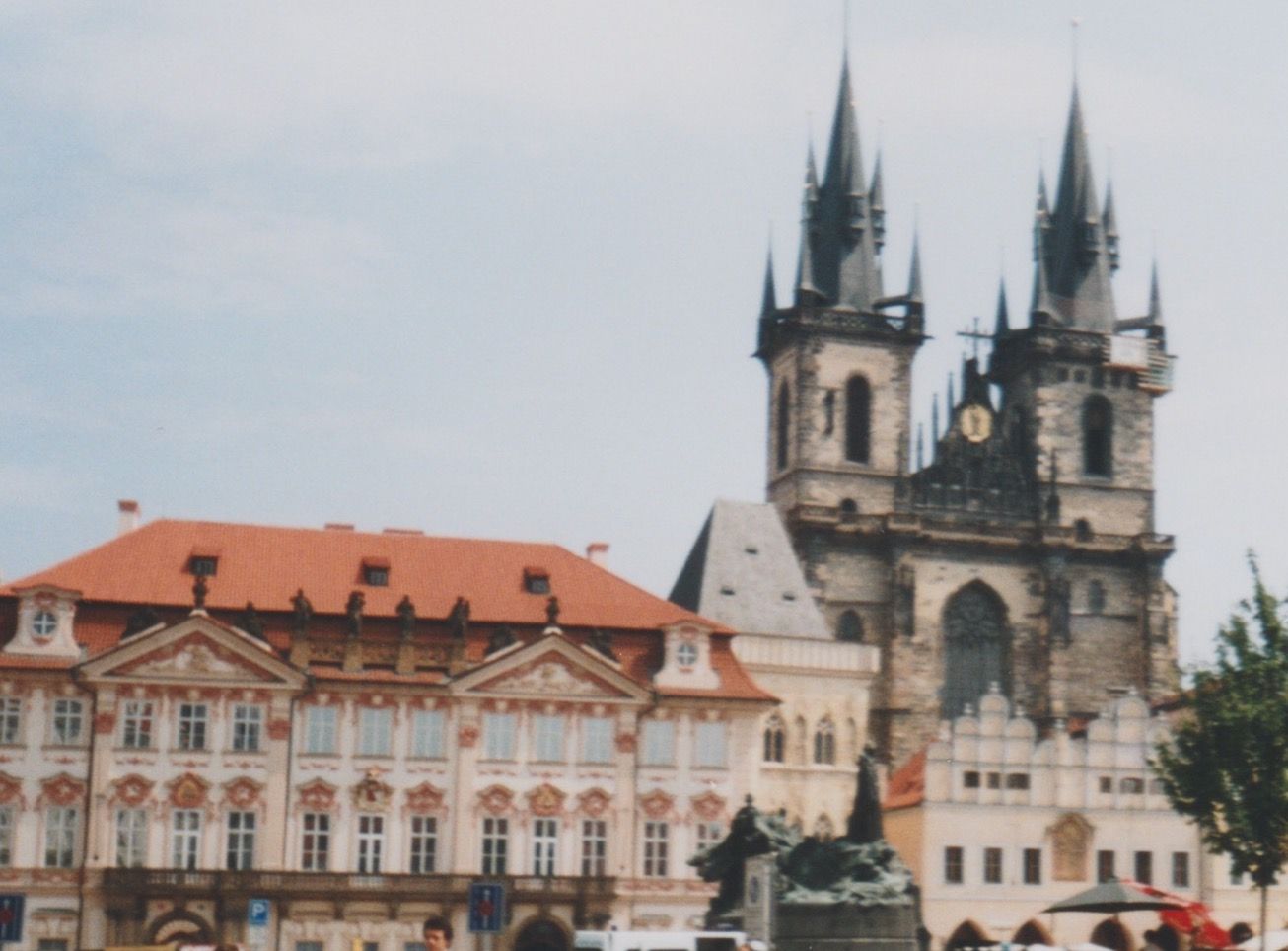
Of particular importance are Prague Castle, the Cathedral of St Vitus, Hradčany Square in front of the Castle, the Valdštejn Palace on the left bank of the river, the Gothic Charles Bridge, the Romanesque Rotunda of the Holy Rood, the Gothic arcaded houses with Romanesque cores around the Old Town Square, the Church of Our Lady in front of Týn, the High Gothic Minorite Church of St James in the Old Town (Staré Mĕsto), the Early Gothic so-called Old-New Synagogue in the Jewish Quarter (Josefov), the late 19th century buildings and the medieval town plan of the New Town (Nové Mĕsto). As early as the Middle Ages, Prague became one of the leading cultural centres of Christian Europe. The Prague University, founded in 1348, is one of the earliest in Europe. The milieu of the University in the last quarter of the 14th century and the first years of the 15th century contributed among other things to the formation of ideas of the Hussite Movement which represented in fact the first steps of the European Reformation.
As a metropolis of culture, Prague is connected with prominent names in art, science and politics, such as Charles IV, Petr Parléř, Jan Hus, Johannes Kepler, Wolfgang Amadeus Mozart, Franz Kafka, Antonín Dvořák, Albert Einstein, Edvard Beneš (co-founder of the League of Nations) and Václav Havel. The Průhonice Park (the area of 211.42 ha) was founded in the year 1885 by the Count Arnošt Emanuel Silva-Tarouca. The result of his lifelong work is an original masterpiece of garden landscape architecture of worldwide importance. The park uses advantage of the miscellaneous valley of the Botič Stream and the unique combination of native and introduced exotic tree species.
The Průhonice Park became in the time of its foundation the entrance gate to Bohemia (as well as to the whole Europe) for newly introduced plants. An integral part of the park is also a Neo-Renaissance country house. In the area there is also a small medieval church of the Nativity of the Virgin Mary.