Historic Fortified City of Carcassonne (UNESCO 345)
Cultural World Heritage in France, inscribed in 1997
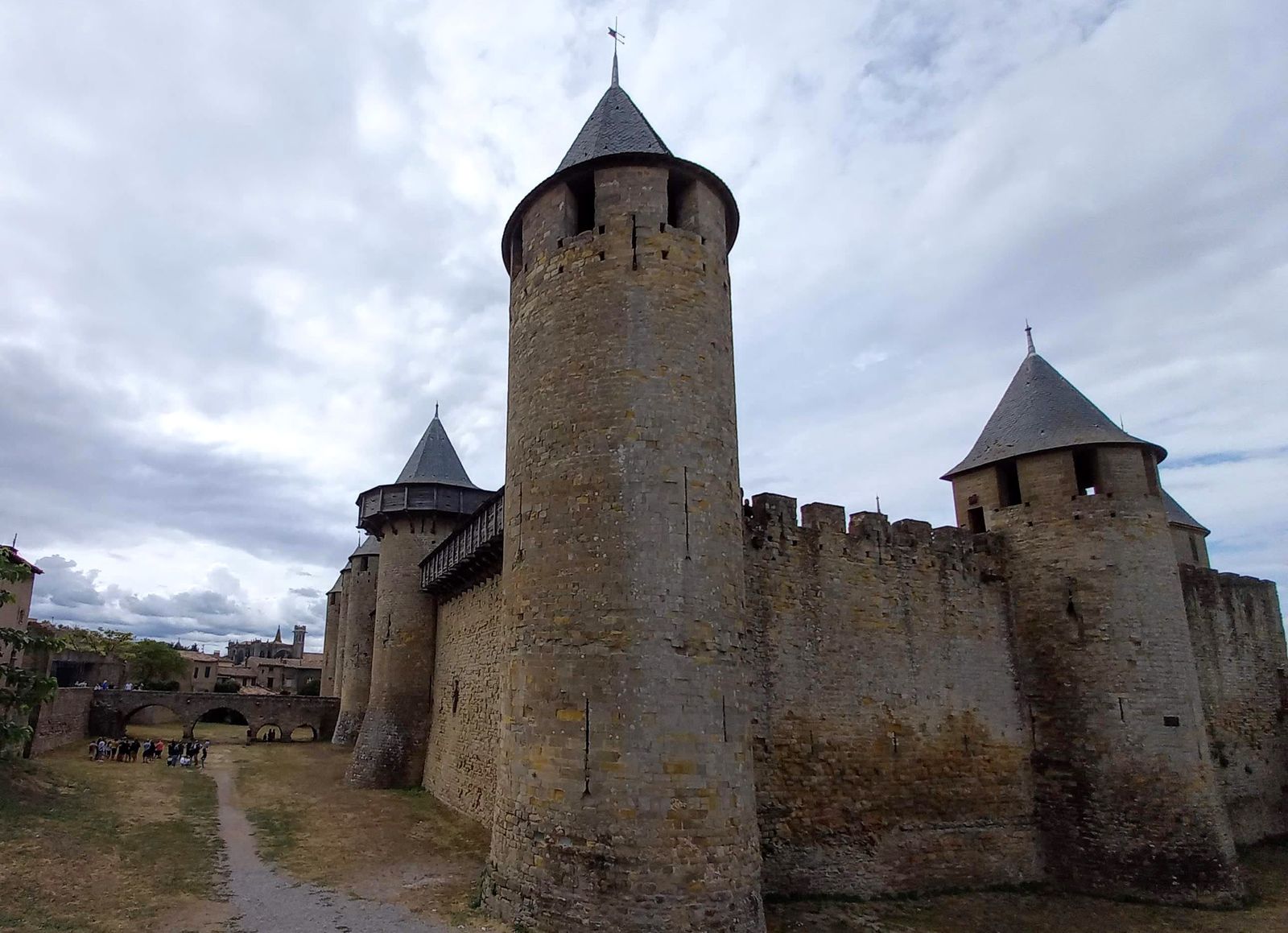
The city of Carcassonne is located in the Occitanie region, in the department of Aude, on a rocky outcrop dominating the course of the Aude and on the historic axis of communication linking the Atlantic to the Mediterranean. Since the pre-Roman period, fortifications have been erected on the hill where Carcassonne is located today. In its present form, it is an outstanding example of a fortified medieval city with an enormous defensive system developed mainly in the 13th century. This system consists of two enclosures separated by barriers surrounding the houses, the streets and the superb Gothic cathedral, as well as the castle and the main buildings associated with it.
The inner ramparts comprise twenty-six circular towers and largely overlap the clearly visible Roman defenses for two-thirds of their length. The outer ramparts have nineteen round towers, three of which are barbicans. The enclosure is surrounded by moats and the two main entrances to the fortified city, the Porte Narbonnaise and the Porte de l'Aude, are particularly elaborate. The 12th century count's castle and the main buildings associated with it were built on the western part of the Roman ramparts.
The basilica dedicated to Saints Nazaire and Celse has no flying buttresses, stability being ensured by the internal vaulted structure. Carcassonne also owes its exceptional importance to the long restoration campaign led from 1853 to 1879 by Eugène Viollet-le-Duc, one of the founders of modern conservation science.
The Committee decided to inscribe this property on the basis of criteria (ii) and (iv), considering that the historic town of Carcassonne is an excellent example of a medieval fortified town whose massive defences were constructed on walls dating from Late Antiquity. It is of exceptional importance by virtue of the restoration work carried out in the second half of the 19th century by Viollet-le-Duc, which had a profound influence on subsequent developments in conservation principles and practice.