Monuments of Oviedo and the Kingdom of the Asturias (UNESCO 312)
Cultural World Heritage in Spain, inscribed in 1985
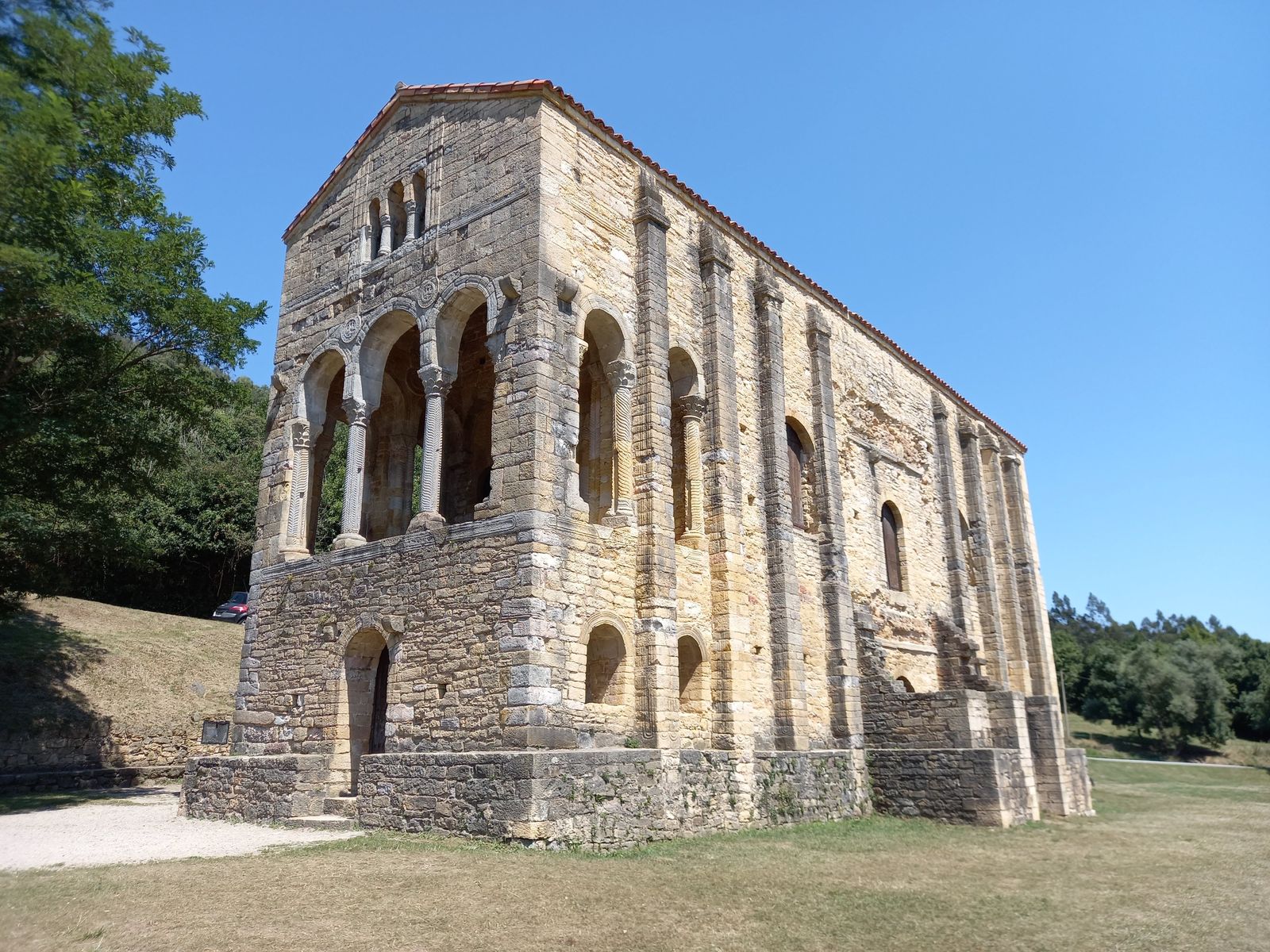
During the 9th century, the flame of Christianity was kept alive in the Iberian peninsula in the small Kingdom of the Asturias where an innovative Pre-Romanesque architectural style was created that was to play a significant role in the development of religious architecture of the peninsula. The Churches of Santa Maria del Naranco (built between 842-850 under Ramiro I, San Miguel de Lillo (also built under Ramiro I, Santa Cristina de Lena (built around 850), the Camara Santa of Oviedo Cathedral and San Julian de los Prados (popularly called “Santullano” and constructed under Alphonse II, between 791-842), located in and around the capital city of Oviedo, are the most representative examples. The group also comprises the remarkable structure of hydraulic engineering known as the “Foncalada” that probably dates back to the first half of the 9th century. Historically, this group of buildings bears witness to cultural traditions relating to the Kingdom of the Asturias.
The Foncalada is an outstanding example of hydraulic engineering of the late Middle Ages in working order, based on Roman models. The architecture of Santa Maria del Naranco takes its inspiration from Late Antiquity and Paleo-Byzantine, as is illustrated in its decorative motifs and iconography, and also in the design of its façades. San Miguel de Lillo retains a decor that reflects a complete record of traditions, expressed in the first original sculpture of the Kingdom of the Asturias. The Camara Santa of Oviedo Cathedral is a two-storey building similar to the funeral structures of classical Rome.
Indeed, the Camara Santa bears witness to these Roman models reproduced, by Paleo-Christian architecture for its martyr shrines. Finally, the Santa Cristina de Lena is a unique example of the pre-Romanesque architecture of the Asturias because of its interior distribution and layout. Overall, these Asturian constructions of small dimensions with a total surface of 815.72 m2 share almost all the characteristics of European architecture of that time : co-existence of multiple typological design, a certain spatial compartmentalization, evident from exterior vestiges, use of material similar to camouflage, rather sombre interiors, heterogeneous decoration based on the panoply of Late Antiquity. These characteristics are due for the most part to their promoters: small monastic communities.