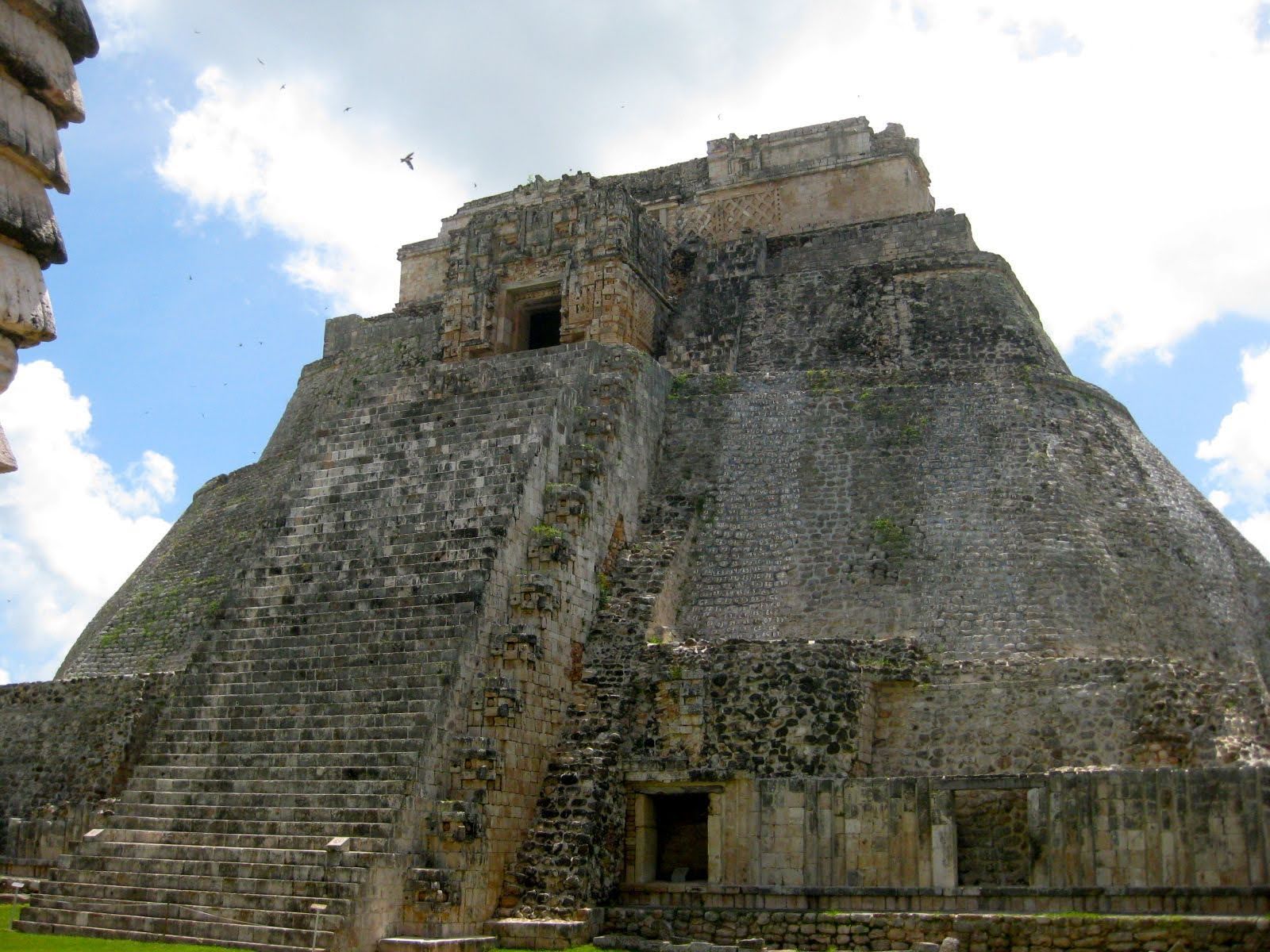
Pre-Hispanic Town of Uxmal (UNESCO 791)
Cultural World Heritage in Mexico, inscribed in 1996
The ruins of the ceremonial structures at Uxmal represent the pinnacle of late Maya art and architecture in their design, layout and ornamentation, and the complex of Uxmal and its three related towns of Kabah, Labná and Sayil admirably demonstrate the social and economic structure of late Maya society. The archaeological site of Uxmal is located 62 kilometers south of Merida, forming the centre of the Puuc ("hill" or "chain of low mountains") region which covers some 7500 km2 in the south-western part of the Mexican state of Yucatan. The region was a centre for trade and the exchange of ideas - and probably also people - with other parts of Mexico. The 16th century A.D.
Maya history known as The Books of Chilam Balam dates the foundation of Uxmal to the later 10th century A.D. Archaeological investigations and radiocarbon dating suggest that the main structures in the complex, including a series of hydraulic works, such as reservoirs for storing rainwater (the chultunoob), were built between the 8th and 10th century A.D. During this period Uxmal grew from a peasant town into a political and administrative centre with up to 20,000 inhabitants. The existence of a town wall reflects a situation of conflict, probably due to the strengthening of other urban centres that eventually contested Uxmal's control of the region; Uxmal was abandoned by its inhabitants after the 10th century A.D. and became no more than a place of pilgrimage until the conquest by the Spanish.
Unlike most other prehispanic towns, Uxmal is not laid out geometrically. Its space is organized in relation to astronomical phenomena, such as the rising and setting of Venus, and adapted to the topography of the site, made up of a series of hills. The main characteristic of Puuc architecture is the division of the facades of buildings into two horizontal elements. The lower of these is plain and composed of carefully dressed blocks broken only by doorways.
The upper level, by contrast, is richly decorated with symbolic motifs in a very plastic style; the individual blocks make up a form of mosaic. There are sculptures over the doorways and at the corners of the upper level, almost invariably composed of representations of the head of Chaac, the rain-god. Some of the most important buildings at the site are the Pyramid of the Soothsayer, the Quadrangle of the Nuns, the Governor's Palace, the House of the Tortoises, the Ball Court, as well as the still not extensively investigated Southern Complex, which includes the Great Pyramid and the Pigeon House. Important buildings at the other sites are the Palace at Sayil, and the Gateway Arch at Labná.
Kabah, which in the region is only second to Uxmal in size and connected to the latter by a sacbe or raised causeway, has the Palace of the Masks or Codz Pop. However, investigation at these sites is still in its beginnings and holds great potential for the future.
The Committee decided to inscribe the nominated property on the basis of cultural criteria (i), (ii) and (iii) considering that the site is of outstanding universal value. The ruins of the ceremonial structures at Uxmal represent the pinnacle of late Mayan art and architecture in their design, layout and ornamentation, and the complex of Uxmal and its three related towns of Kabáh, Labná and Sayil admirably demonstrate the social and economic structure of late Mayan society.