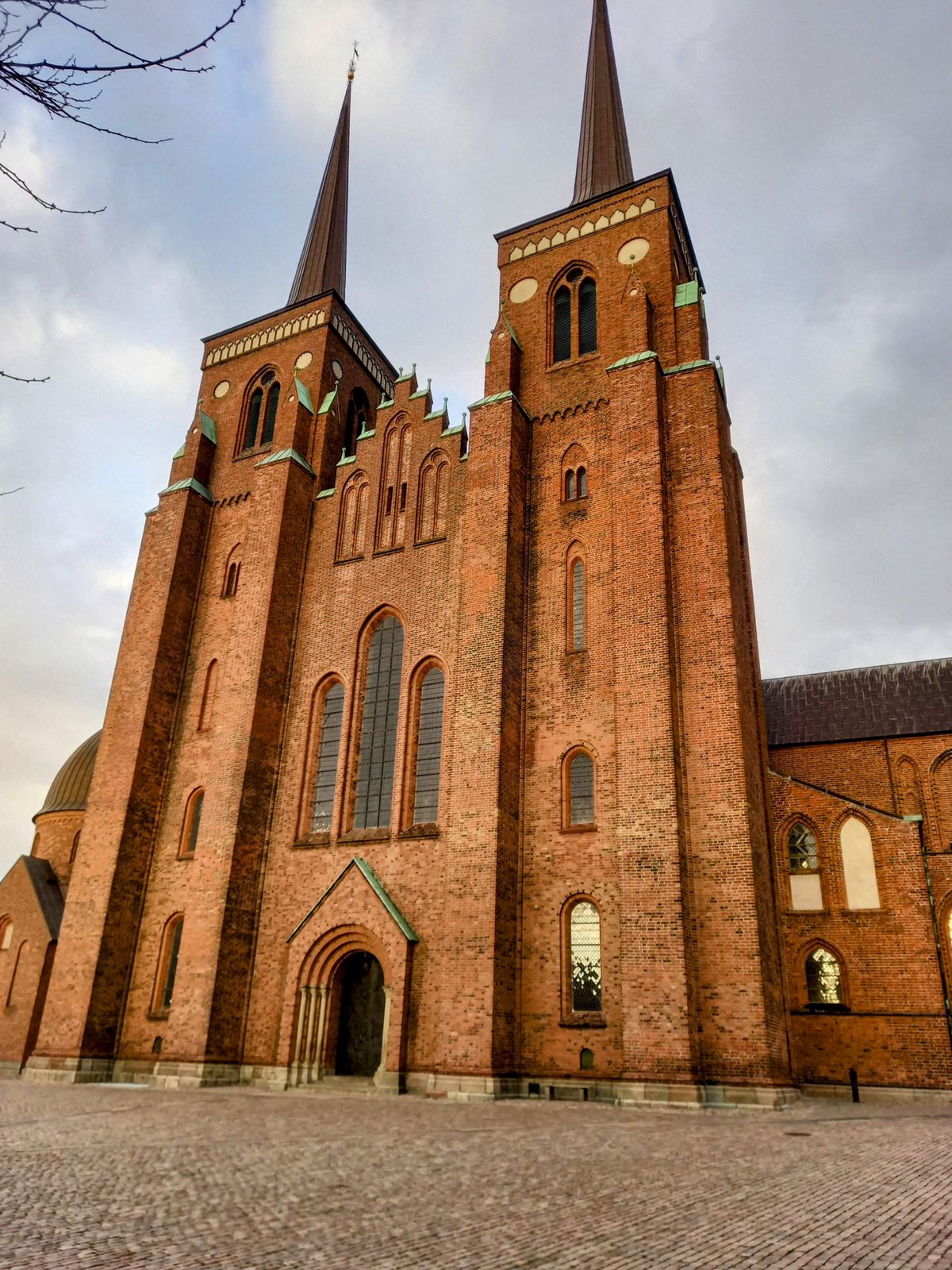
Roskilde Cathedral (UNESCO 695)
Cultural World Heritage in Denmark, inscribed in 1995
Roskilde Cathedral, on the Island of Zealand is a large brick-built aisled Gothic-style basilica, with twin spires and a semi-circular gallery within. Placed on a small hilltop overlooking the Roskilde Fjord the Cathedral is a very significant landmark. Around it, in its setting, the structure of the medieval town is still visible, within which, some medieval buildings and a number of fine 17th and 18th century houses remain. Built about 1170, the original Cathedral structure was in Romanesque form but, when half-built, the plan was changed under the influence of the incoming Gothic style from France.
In the following centuries, chapels, porches, and other structures were added, each in the current architectural style of the time. As a result, the Cathedral has emerged as an epitome of the history of European architecture in a single structure. As with many early structures, the bricks in the external walls vary in size and colour. The interior walls were originally left bare, apart from the vault and arch soffits, which were plastered.
The entire interior was subsequently coated with a greyish-yellow coloured smooth stucco, and most of the rich original wall paintings have disappeared. The Cathedral's royal monuments commemorate an outstanding series as royal burials that have occurred from the 10th century until the present time. With only one exception since the reformation, all Danish kings and queens have been buried in the Cathedral, their tombs representing the evolution of funerary monumental art. Roskilde Cathedral is an outstanding example of the early use of brick in the construction of large religious buildings in Northern Europe.
Because of the successive addition of chapels and porches to commemorate Danish royalty since the 16th century, it is also an exceptional example of the evolution of European architectural styles in a single structure.