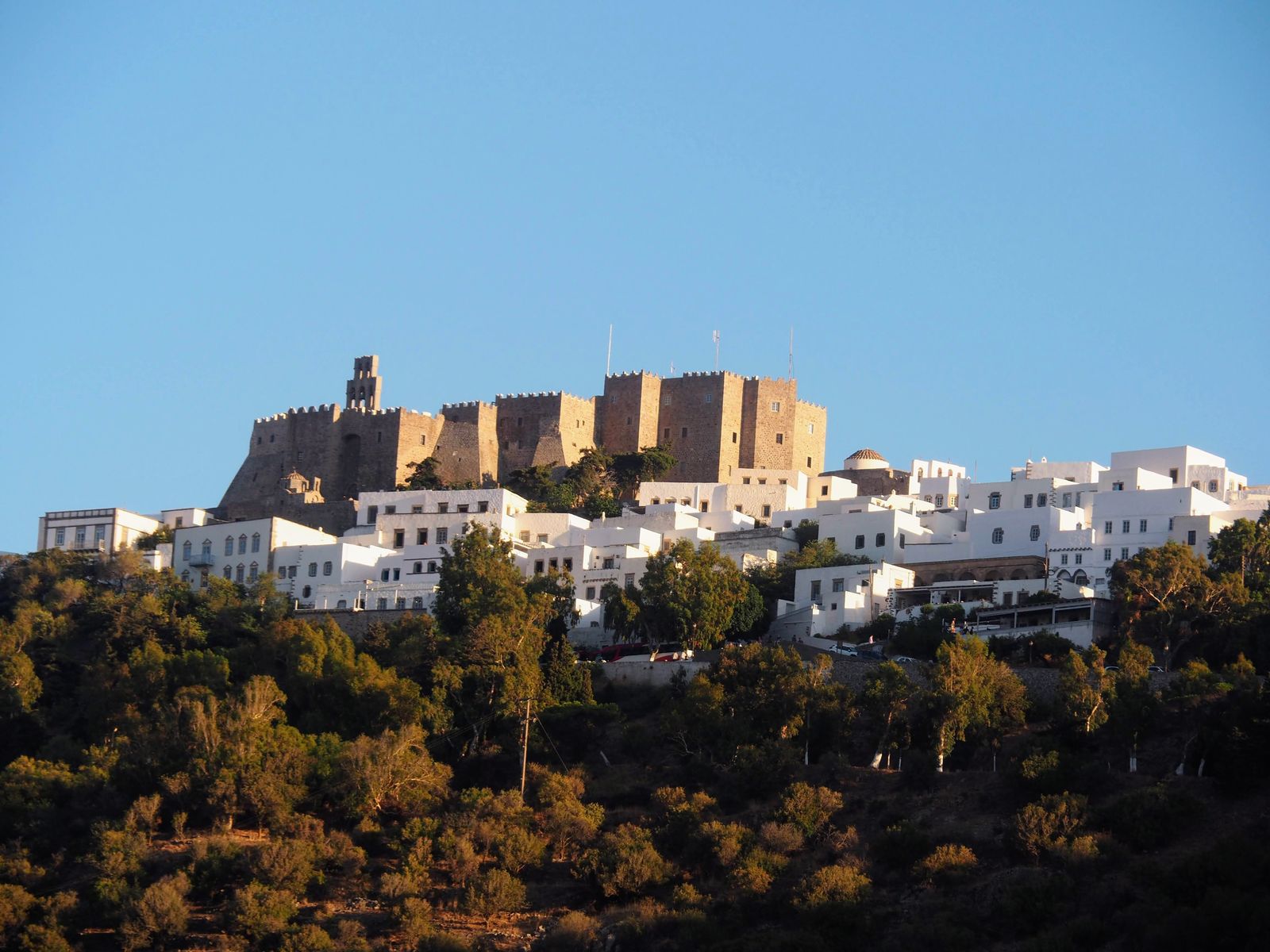
The Historic Centre (Chorá) with the Monastery of Saint-John the Theologian and the Cave of the Apocalypse on the Island of Pátmos (UNESCO 942)
Cultural World Heritage in Greece, inscribed in 1999
The small island of Pátmos in the Dodecanese is reputed to be where Saint John the Theologian wrote both his Gospel and the Apocalypse around 95 AD. A monastery dedicated to the ‘beloved disciple’ was founded there in 1088 by Hosios Christodoulos Latrinos and has been a place of pilgrimage and Greek Orthodox learning ever since. Its foundation was part of Emperor Alexios I Komnenos’ policy to colonize the islands and create a base in the Aegean. The colonization of the Chóra of Pátmos took place gradually around the fortified monastic complex, which always had the absolute dominance over the island as the main governor and regulator of the organization of the social life of the islanders.
The monastery of St John the Theologian is a unique creation, integrating monastic values within a fortified enclosure, which has evolved in response to changing political and economic circumstances for over 900 years. It has the external appearance of a polygonal castle, with towers and crenellations. It is also home to a remarkable collection of manuscripts, icons, and liturgical artwork and objects. The earliest elements, belonging to the 11th century, are the Katholikón (main church) of the monastery, the Chapel of Panagía, and the refectory.
The north and west sides of the courtyard are lined with the white walls of monastic cells and the south side is formed by the Tzafara, a two-storeyed arcade of 1698 built in dressed stone, whilst the outer narthex of the Katholikón forms the east side. Midway along the road that winds steeply up from Skála to Chorá is the Cave of the Apocalypse (Spilaion Apokalypseos), where according to tradition St John dictated the Book of Revelation and his Gospel to his disciple Prochoros. This holy place attracted a number of small churches, chapels, and monastic cells, creating an interesting architectural ensemble. The old settlement of Chóra, associated with it contains many religious and secular buildings.
It is one of the best preserved and oldest of the Aegean Chorá. Beginning in the 13th century, the town was expanded by new quarters in the 15th century for refugees from Constantinople (the Alloteina) and in the 17th century from Crete (the Kretika). Paradoxically, perhaps, Patmos thrived as a trading centre under Ottoman occupation, reflected by fine merchants’ houses of the late 16th and 17th centuries in Chorá. The town contains a number of fine small churches.
Dating mostly from the 17th and 18th centuries, they contain important mural paintings, icons, and other church furnishings. The elements of the property are unique in several ways, considered both as an ensemble and individually. Pátmos is the only example of an Orthodox monastery integrating from its origins a supporting community, the Chorá, built around the hill-top fortifications. While fortified monasteries may be found in other parts of the Orthodox world, the Monastery of Hagios Ioannis Theologos is the only example in Greece of an organized settlement around a fortified monastic complex.
Criterion (iii): The town of Chorá on the island of Pátmos is one of the few settlements in Greece that have evolved uninterruptedly since the 12th century. There are few other places in the world where religious ceremonies that date back to the early Christian times are still being practised unchanged.
Criterion (iv): The Monastery of Hagios Ioannis Theologos (Saint John the Theologian) and the Cave of the Apocalypse on the island of Pátmos, together with the associated medieval settlement of Chorá, constitute an exceptional example of a traditional Greek Orthodox pilgrimage centre of outstanding architectural interest.
Criterion (vi): The Monastery of Hagios Ioannis Theologos and the Cave of the Apocalypse commemorate the site where St John the Theologian (Divine), the “Beloved Disciple”, composed two of the most sacred Christian works, his Gospel and the Apocalypse.