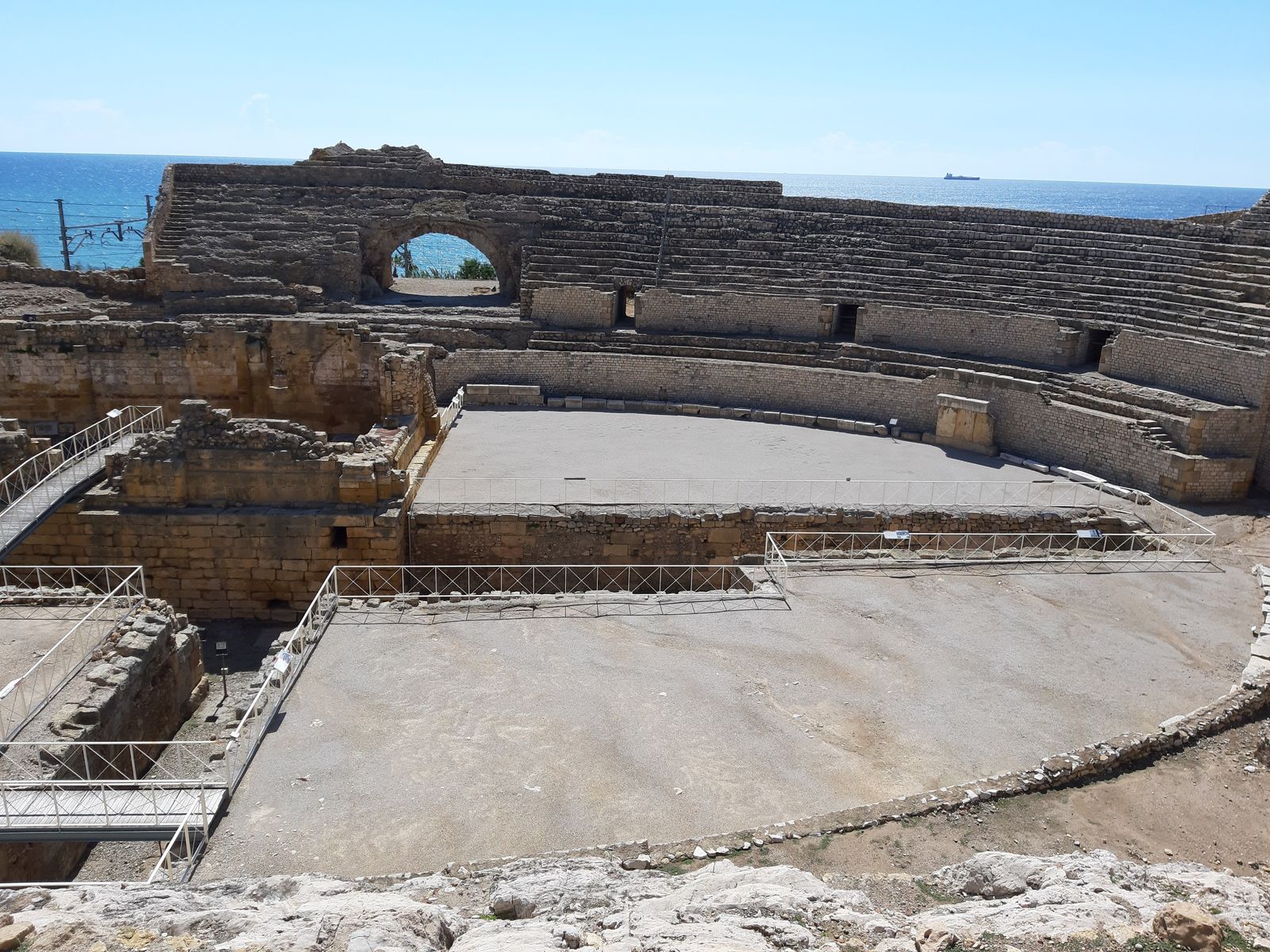
Archaeological Ensemble of Tarraco (UNESCO 875)
Cultural World Heritage in Spain, inscribed in 2000
The Archaeological Ensemble of Tarraco is located in Tarragona, in the Autonomous Region of Catalonia, in the northeast of the Iberian Peninsula. The city of Tarraco was the first and oldest Roman settlement on the Iberian Peninsula and capital of most of the peninsular territory, the province of Hispania Citerior. It was a major administrative and mercantile city in Roman Spain and the major centre of the Imperial cult for all the Iberian provinces. Tarraco was endowed with many fine buildings, and archaeological excavations have revealed parts of the Roman settlement from the foundation of the city in the Republican period (3rd century BCE) to the Early Christian Era.
The serial property encompasses a total area of 32.83 ha and is comprised of the Roman city of Tarraco, the present day city of Tarragona, and a number of elements within the surrounding territory: Roman walls, the Imperial cult enclosure, the Square with representation of the provincial forum, the Circus, the Colony forum, the Roman theatre, the Amphitheatre, the Visigoth basilica and Romanesque church, the Early Christian necropolis, the Hydraulic conduits from Tarraco to Les Ferreres aqueduct, the Tower of the Scipios, the Mèdol quarry, the Centcelles villa and mausoleum, the Els Munts villa and Berà Arch. Tarraco is remarkable for its singular conception within Roman planning: the town plan was adapted to the configuration of the land by means of a series of artificial terraces, which can be seen around the provincial forum as well as in the residential area of the Roman city. The distribution reveals an upper part, which dominates the whole city and is devoted to representation, part provincial officialdom and part recreational. Meanwhile, following the natural contours of the ground, the residential city with its colony forum stretches out to the sea and the port.
The defensive system of walls of Tarraco is one of the earliest examples of Roman military engineering on the Iberian Peninsula and the most important symbols of the town, defining its form from antiquity until the 19th century. This large group of buildings determined the layout of the existing old town, where most of the architectural elements survive. It was a large complex spread over three terraces used for high-level political purposes and to bring the communities of Hispania Citerior into the Roman Empire, as shown by the iconography of sculptural and decorative finds. The architectural details and the use of imported materials are taken as evidence of its architects and craftsmen having been brought in from Rome.
The quality of the materials and marbles used is remarkable, as is the richness of the architectural and sculptural decoration, which gives an idea of the grandeur of Imperial Tarraco. The different elements built in the dependent territory of the city are also noteworthy.
Criterion (ii): The Roman remains of Tárraco are of exceptional importance in the development of Roman urban planning and design and served as the model for provincial capitals elsewhere in the Roman world.
Criterion (iii): Tárraco provides eloquent and unparalleled testimony to a significant stage in the history of the Mediterranean lands in antiquity.