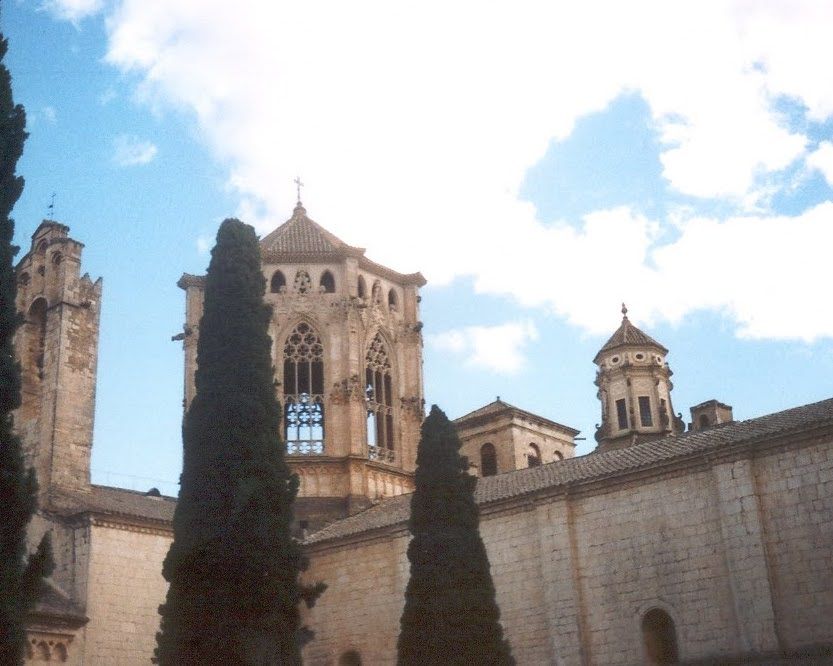
Poblet Monastery (UNESCO 518)
Cultural World Heritage in Spain, inscribed in 1991
Poblet Monastery is located in the south of Catalonia, in the northeast of the Iberian Peninsula, in the municipality of Vimbodí. It is one of the largest and most complete Cistercian abbeys in the world. It was built in the 12th to 15th centuries around a church that dates to the 13th century. It is impressive for the majesty of its architecture and includes a fortified royal residence as well as the pantheon of the kings and queens of Catalonia and Aragon.
The Monastery is structured as three enclosures, surrounded by a defensive wall. The first outer enclosure contains buildings from the 16th century, such as storehouses, workshops, housing for lay workers and other premises connected with the financial life of the community. This enclosure also contains the Gothic chapel of Sant Jordi, built in 1452. The fortified Golden Door gives access to the second enclosure, made up of the Plaça Major, or Main Square, around which stand the remains of the hospital for the poor, the Romanesque chapel of Santa Caterina and the treasury.
The third and innermost enclosure is fortified and includes the church, cloister and monastic rooms. The defensive wall is crenulated and is strengthened by a series of square or polygonal towers, two of which flank the Royal Doorway. The church is on a three-aisled basilical plan with transepts and an apsidal east end with ambulatory. The ceiling consists of a pointed vault in the central aisle and ribbed vaults on the side aisles.
Notable features of the interior of the church are the Renaissance retable and the royal tombs. Mature Gothic forms dominate the great cloister. The earliest parts of the structure are the south gallery and the lavabo around which the oldest buildings of the complex (12th and 13th centuries) are distributed: the chapter house, the refectory, the kitchen and calefactory, the library, the old scriptorium, and the dormitory, built over the library and chapter house. Poblet Monastery is extraordinarily important in terms of art, culture, history and spirituality and for its key role in the repopulation and agricultural exploitation of New Catalonia under the Crown of Aragon.
Its library and scriptorium were well known from the 13th century onwards for their works on law and history, and the monastery served as a custodian of the history of the dynasty as well as the Royal remains. It is also one of the most important and sumptuous Cistercian monasteries where the functional plan and spirit of the monastery are present throughout its structure. The spiritual quality of the life of Poblet Monastery has also made it a very important centre in the life of the country, from the time of its foundation until the present day.