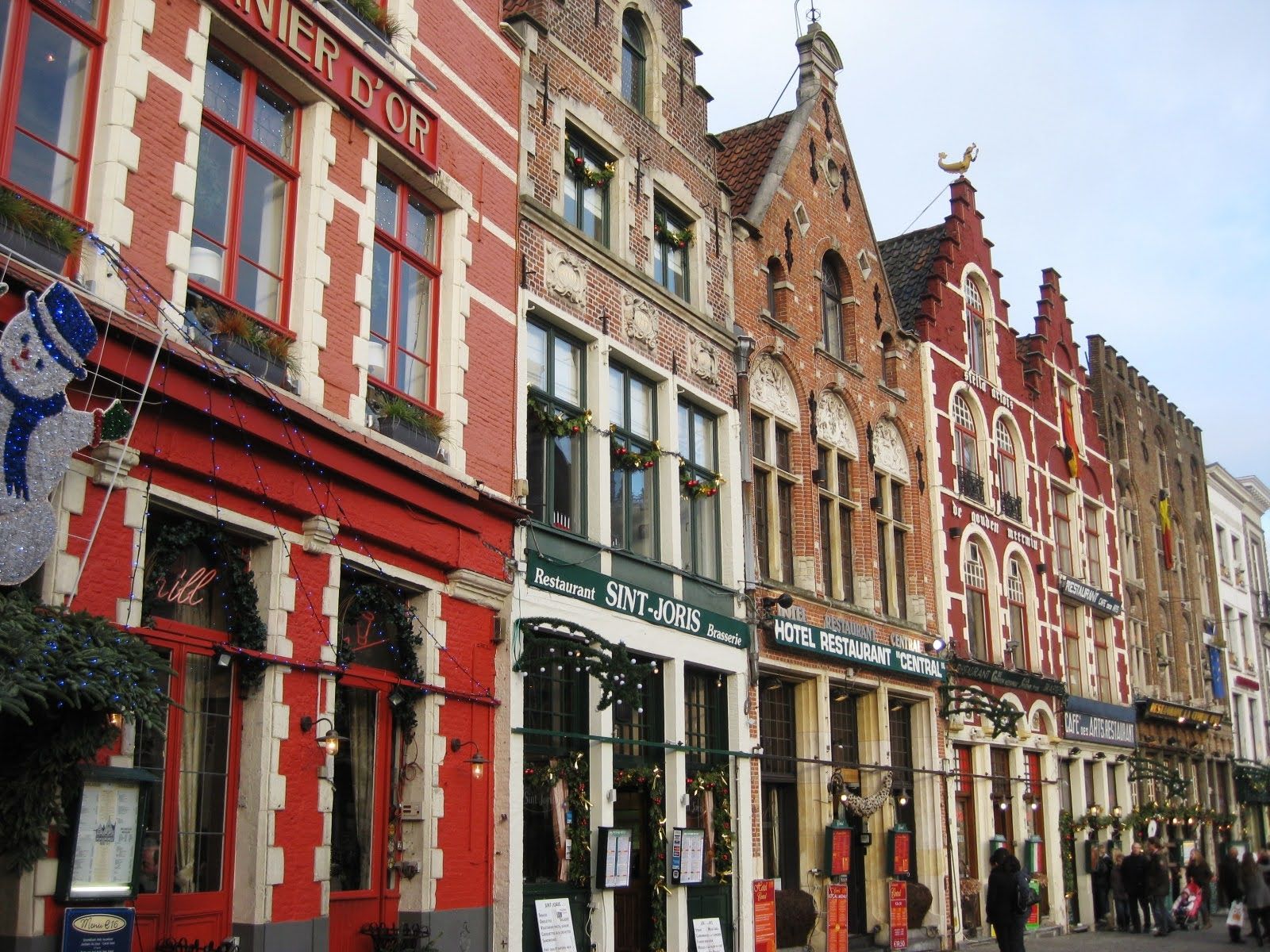
Historic Centre of Brugge (UNESCO 996)
Cultural World Heritage in Belgium, inscribed in 2000
The Historic Centre of Brugge is an outstanding example of an architectural ensemble, illustrating significant stages in the commercial and cultural fields in medieval Europe. Brugge in medieval times was known as a commercial metropolis in the heart of Europe. The city reflects a considerable exchange of influences on the development of art and architecture, particularly in brick Gothic, which is characteristic of northern Europe and the Baltic. This architecture strongly determines the character of the historic centre of the city.
The 12th century city walls marked the boundaries of the medieval city. Although the walls themselves are lost today, they remain clearly visible, emphasized by the four surviving gates, the ramparts and one of the defence water towers. The medieval street pattern, with main roads leading towards the important public squares, has mostly been preserved, as well as the network of canals which, once used for mercantile traffic, played an important role in the development of the city. In the 15th century, Brugge was the cradle of the Flemish Primitives and a centre of patronage and painting development for artists such as Jan van Eyck and Hans Memling.
Many of their works were exported and influenced painting styles all over Europe. Exceptionally important collections have remained in the city until today. Even after its economic and artistic peak at the end of the Middle Ages, building and urban development continued, although Brugge mostly missed the 19th-century industrial revolution. In the 18th and 19th centuries, many medieval parcels were joined to larger entities and new quarters were also developed.
The most striking examples of large scale post-medieval interventions in the historic centre are the urbanization around Coupure (1751-1755), the Zand and the first railway station (1838), the Theatre quarter (1867), the Koningin Elisabethlaan and Gulden Vlieslaan (1897) and the creation of the Guido Gezelle-neighbourhood (1920-1930). In the second half of the 20th century, some major changes occurred with Zilverpand (1976), the new Public Library (1975-1978), the new Palace of Justice and Kartuizerswijk (1980), Clarendam (1990) and Colettijnenhof (1997). Brugge is characterized by a continuity reflected in the relative harmony of changes. As part of this continuity, the late 19th century renovation of facades introduced a Neo-Gothic style that is particular for Brugge.
The Brugge ‘neo’ style of construction and its restoration philosophy became a subject of interest, study and inspiration. Still an active, living city today, Brugge has preserved the architectural and urban structures which document the different phases of its development including the central Market Place with its belfry, the Béguinage, as well as the hospitals, the religious and commercial complexes and the historic urban fabric.
Criterion (ii): The Historic Town of Brugge is testimony, over a long period, of a considerable exchange of influences on the development of architecture, particularly in brick Gothic, as well as favouring innovative artistic influences in the development of medieval painting, being the birthplace of the school of the Flemish Primitives.
Criterion (iv): The Historic Town of Brugge is an outstanding example of an architectural ensemble, illustrating significant stages in the commercial and cultural fields in medieval Europe, of which the public, social, and religious institutions are a living testimony.
Criterion (vi): The town of Brugge has been the birthplace of the Flemish Primitives and a centre of patronage and development of painting in the Middle Ages with artists such as Jan van Eyck and Hans Memling.