Historic Site of Lyon (UNESCO 872)
Cultural World Heritage in France, inscribed in 1998
Located in the Auvergne-Rhône-Alpes region, at the confluence of the Saône and the Rhône Rivers, the city of Lyon is dominated by two hills: Fourvière to the west and Croix-Rousse to the east. The long history of Lyon, from a proto-urban agglomeration from the Celtic era to its founding by the Romans with the capital of Trois Gaules in the 1st century BC, has continued to play a major role in Europe’s political, cultural and economic development, and is vividly illustrated by its urban fabric and the many fine historic buildings dating from all periods. Humans have settled at this site destined for urbanization for more than two thousand years and built a city whose stages of development are still visible today: from the Roman vestiges of antique Lugdunum to the medieval streets on the slopes of Fourvière and the Renaissance dwellings of Vieux-Lyon, from the peninsula with a wealth of classical architecture to the slopes of Croix-Rousse with its very particular canut dwellings, which bear witness to an essential page in the history of the labouring classes of the 19th century. Among the outstanding examples are the Thomassin House, on the Place du Change (late 13th century, enlarged in the 15th century); the Claude de Bourg House (1516), the house of the poet Maurice Scève (1493, additional storey in the 17th century), the Chamberlain’s mansion (1495-1516), illustrating the transition from Gothic to French Renaissance style, the Mannerist House of the Lions (1647), the classical building on the Quai Lassagne (1760), and the “House of 365 Windows” and the “Courtyard of the Voracious”, striking examples of the tenements built for the canuts in the first half of the 19th century.
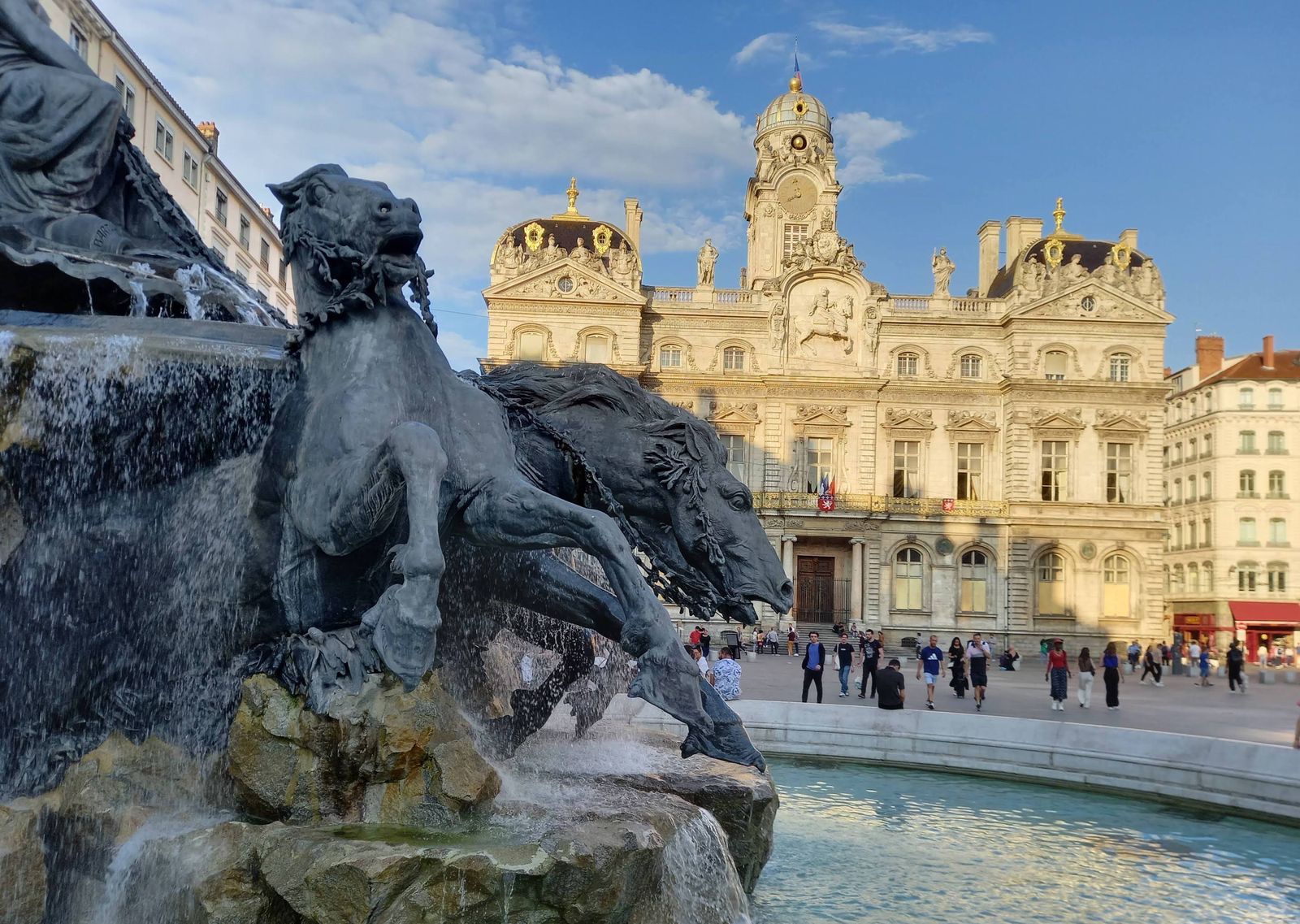
Among the public buildings, mention should be made of the late 11th-century Manécanterie (scola cantorum); the Ainay Abbey Church (1107), of pure Romanesque style; the Cathedral of St John the Baptist (1160-1481), which retains a remarkable degree of stylistic homogeneity, despite the long period of construction; the Church of St Nizier, begun in the 14th century and completed in 19th century, with its Flamboyant Gothic nave, its typical classical Renaissance façade and its neo-Gothic spire; the imposing Hôtel de Ville (1646-1703); the 17th-18th century Hôtel-Dieu built over a medieval original; the Loge du Change (1745-80), now in use as a Protestant church; the Fourvière Basilica (1872-96), one of the most important landmarks of the city; and the Weaving School, the work of modernist architect Tony Garnier (1927-1933). The specificity of Lyon is its progressive expansion towards the east while preserving, at each stage of its growth, the richness of its earlier dwellings. Unlike many other cities where the centre was destroyed in order to be rebuilt in the same place with new architecture, Lyon’s centre has shifted location, enabling the safeguarding of whole districts whose permanence renders the history of the city visible on the buildings themselves.
Criterion (ii): Lyon bears exceptional testimony to the continuity of urban settlement over more than two millennia on a site of great commercial and strategic significance, where cultural traditions from many parts of Europe have come together to create a coherent and vigorous continuing community.
Criterion (iv): By virtue of the special way in which it has developed spatially, Lyon illustrates in an exceptional way the progress and evolution of architectural design and town planning over many centuries.