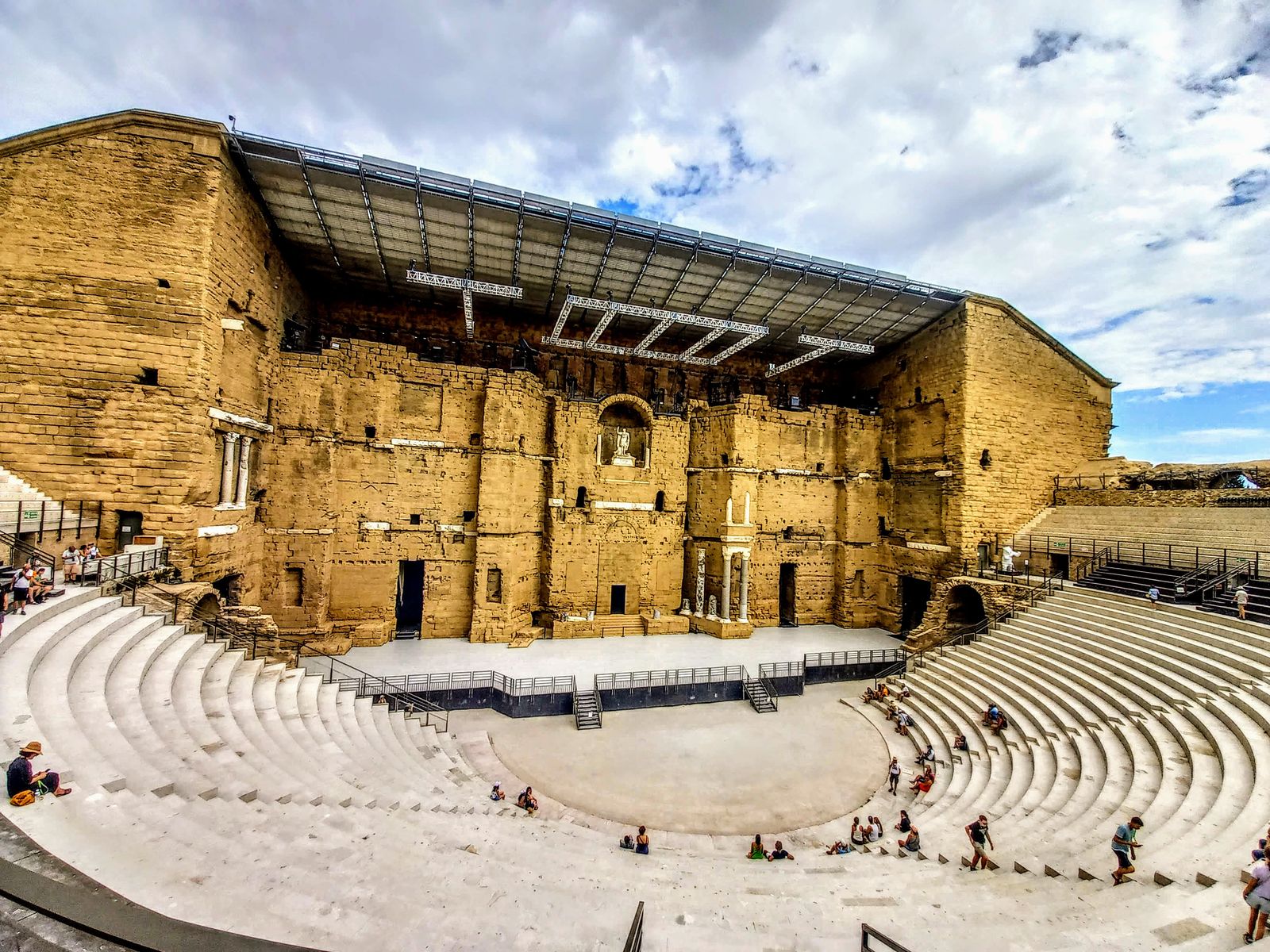
Roman Theatre and its Surroundings and the "Triumphal Arch" of Orange (UNESCO 163)
Cultural World Heritage in France, inscribed in 1981
Situated in the Rhône Valley, in the Provence-Alpes-Côte-d'Azur region, the ancient theatre of Orange, with its 103 m long and 37 m high facade, is one of the best preserved of all the great Roman theatres. Built in the beginning of the Christian era, the ancient theatre presents all the components of the Latin Theatre according to Vitruvius: the cavea (semicircular tiers), the lateral accesses and the surprisingly preserved stage wall flanked by parascenia. Columns and numerous statues in niches originally decorated the stage. Only a few vestiges remain of this original decoration, including the statue of Augustus displaced to the large central niche.
Closed by Imperial decree in 391, the theatre was abandoned and, later, ransacked and looted by Barbarians. It was not until the 19th century that the ancient theatre was reborn thanks to the restoration work begun in 1825. Built between 10 and 25 AD, the Roman Triumphal arch of Orange is one of the most beautiful and interesting provincial triumphal arches of the Augustan Age that has come down to us, thanks to its low reliefs commemorating the establishment of the Pax Romana. On its north and south sides, Celtic weapons from the period of independence appear in fan shape on a wall; on its east and west sides, the Celts are represented in chains.
In addition to this decoration, there are naval remains where prows, oars, anchors and aplustre, recall the control over the maritime world that the victory of Actium gave to Rome. Finally, on the upper attic, Roman and Celtic cavalrymen and infantrymen clash. Transformed into a fort in the 13th century, partially repaired in the 18th century, then restored in the 19th century, the Triumphal Arch of Orange remains one of the most remarkable monuments of Roman Gaul.