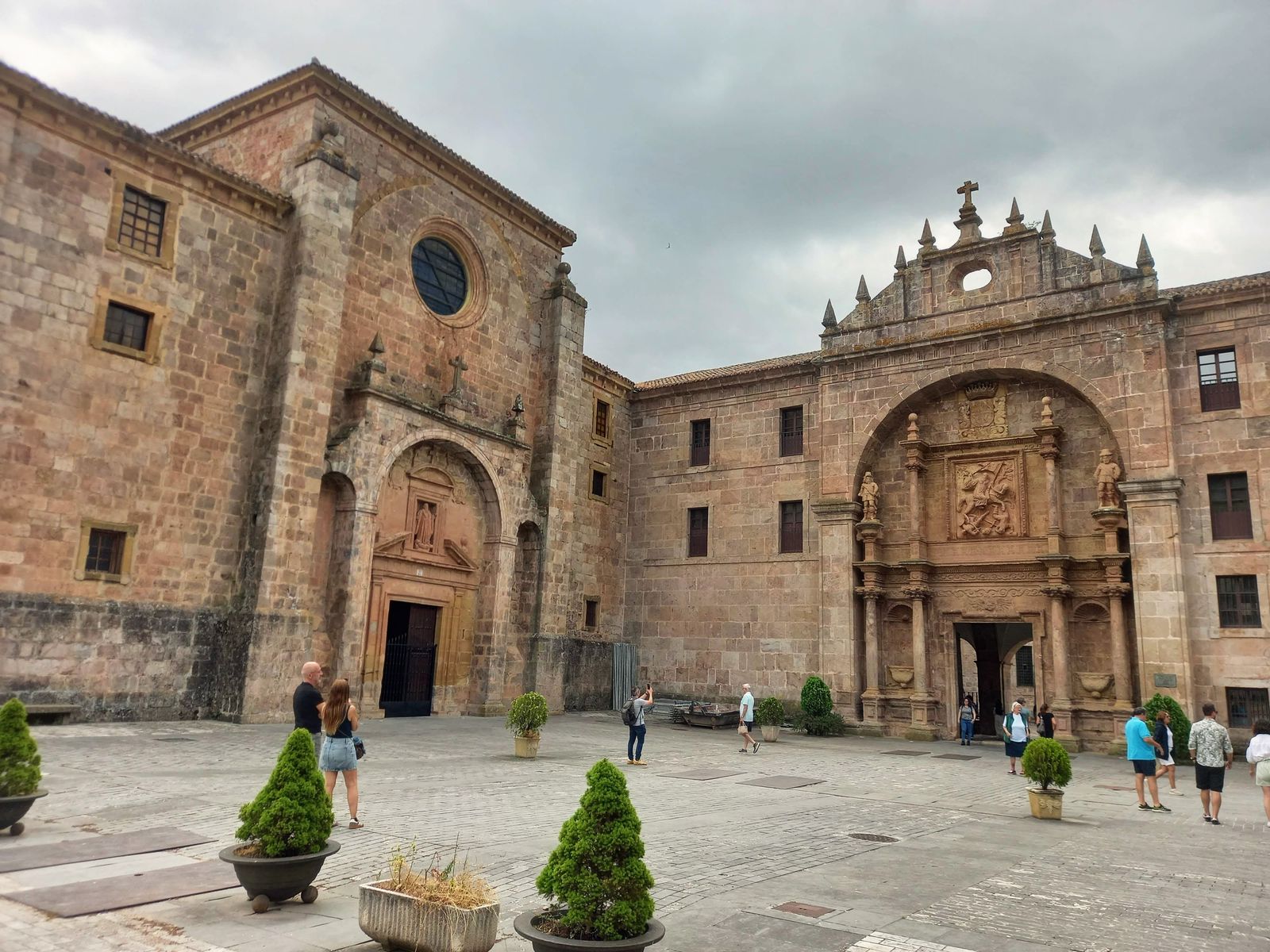
San Millán Yuso and Suso Monasteries (UNESCO 805)
Cultural World Heritage in Spain, inscribed in 1997
San Millán Yuso and Suso Monasteries are located in the Autonomous Community of La Rioja, in the north of Spain. The property has an area of 19 hectares with a buffer zone. Because of the identification and inter-relationship of the two monasteries with elements of the Moorish, Visigothic, Mediaeval, Renaissance and Baroque styles, the architecture and the natural landscape bring together highly significant periods in the history of Spain. In the mid-6th century, Saint Millán settled in a religious site – now the Monastery of Suso – on the flanks of the Cogolla or Distercios hills, where he was joined by other eremitic monks to found the Cogolla Community.
It became, with time, a place of pilgrimage. A beautiful Romanesque church was erected in Suso, which stands intact to the present day, in honour to this saint. Subsequently, in 1503 King Garcia Sanchez of Najera ordered the construction of the Monastery of Yuso – meaning “lower” or “below” – on land below the Suso Monastery, which is where the monks continue the activities initiated in the Monastery of Suso. These continue to the present day.
The Monastery of Suso is comprised of a series of hermits’ caves, a church, and an entrance porch or narthex. The caves, originally used by the monks, are cut into the southern slope of the mountain. The current uncommon shape and orientation date back to the rebuilding carried out in the 16th century, which extended the Moorish structure and thus included the rear portico inside the church. Archaeological excavations in advance of the consolidation work on the west side of the church have revealed the foundations of a number of other monastery buildings.
Research has also helped in identifying the location of caves used by the coenobites on the hillside above and around the church. The main buildings of the Monastery of Yuso, next to the modern village and below the Monastery of Suso, cluster around a small cloister known as the Canons’ Cloister (Patio de la Luna) and the main cloister, named after San Millán. The latter has two storeys. The lower storey is open and roofed with star-ribbed vaulting, and the upper storey is enclosed and houses the museum.
The Spanish language was “born” in the Monasteries of San Millán de Suso and San Millán de Yuso, and therefore they represent an essential part of the history of humanity. The Codex Aemilianensis 60 was written in the Suso scriptorium during the 9th and 10th centuries by one of the monks, who added marginal notes in Castilian and Basque, along with a prayer in Castilian, to clarify passages in the Latin text; this is the first known example of written Spanish. It was in this monastery, during the 13th century, that Gonzalo de Berceo wrote his first poems in Castilian in one of the church’s porticoes. The Suso Monastery is of great cultural interest so far as the early development of monasticism in Europe is concerned, since it represents the transition from an eremitic to a cenobitic community vividly in material terms.
The continued survival of the community to the present day in the Yuso Monastery gives a very full picture of the trajectory of European monasticism. Since the Monastery was founded in the 6th century by San Millán and his disciples, this site has been a centre of culture, history and religion for the north of Spain and the rest of the country. This religious site was strongly supported by the Royal House of Navarre, as well as by the Counts, Kings and Queens of Castile, during the 10th and 11th centuries. Of great universal associative importance is the fact that the Spanish language, one of the most common in the whole world today, was first written down here.
The Committee decided to inscribe this property on the basis of criteria (ii), (iv) and (vi), considering that the Monasteries of Suso and Yuso at San Millán de la Cogolla are exceptional testimony to the introduction and continuous survival of Christian monasticism, from the 6th century to the present day. The property is also of outstanding associative significance as the birthplace of the modern written and spoken Spanish language.