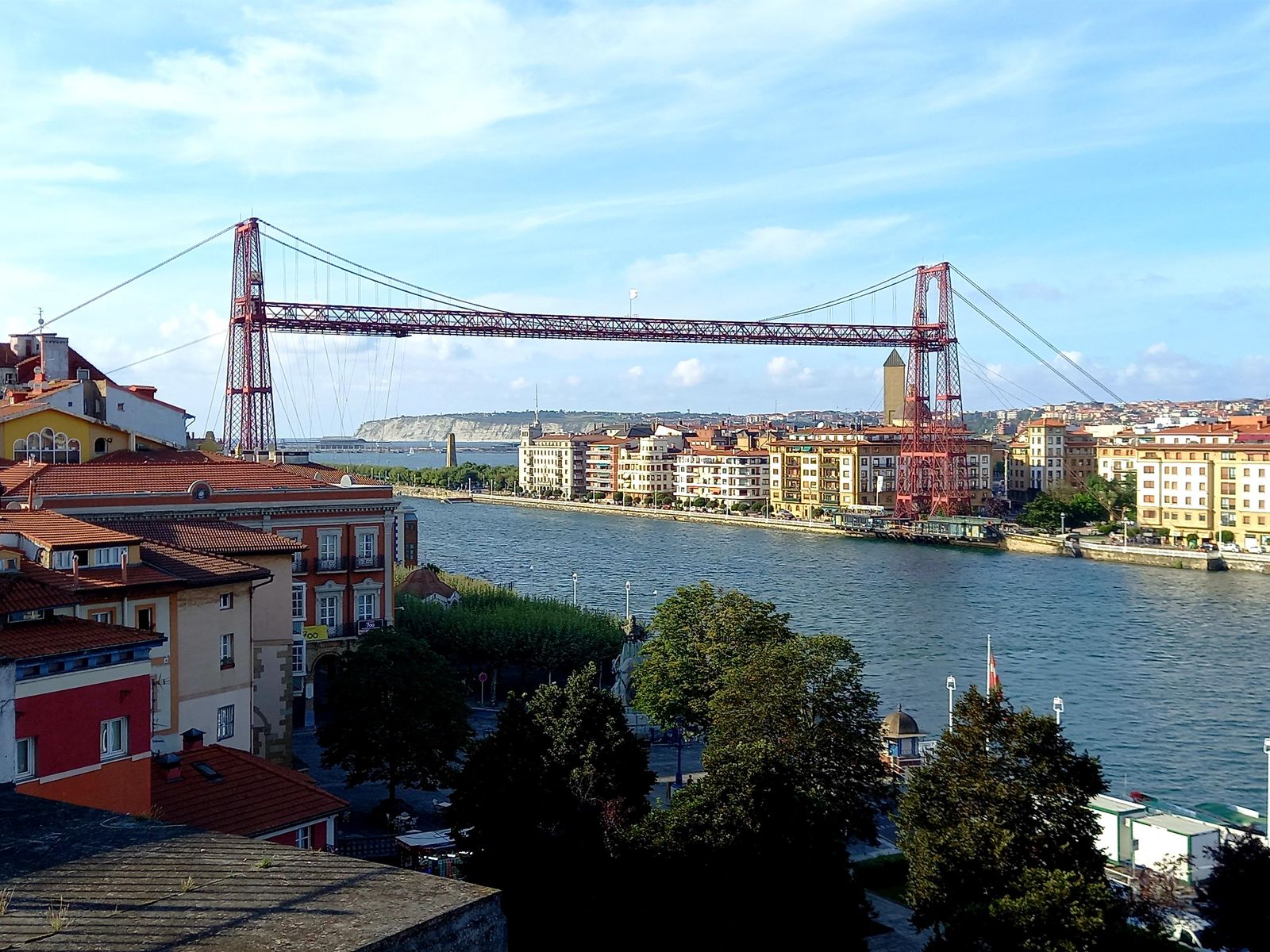
Vizcaya Bridge (UNESCO 1217)
Cultural World Heritage in Spain, inscribed in 2006
The Monumental Vizcaya Hanging Bridge is an infrastructure located in the north of the Iberian Peninsula, over the mouth of the River Ibaizabal, at the point where the navigable estuary of Bilbao opens out to the sea. It spans the two banks of the river, thereby connecting the municipalities of Getxo and Portugalete. It was designed by the Basque architect, Alberto de Palacio, who devised the first bridge in the world with a hanging transporter – which transports passengers and vehicles by means of a gondola suspended high above the passing ships. Its construction is outstanding for merging 19th-century ironworking traditions, taken from the railways, with the new lightweight technology of twisted steel cables, designed by the Frenchman Ferdinand Arnodin.
Constructed on private initiative between 1887 and 1893, the bridge has worked almost without interruption since it was built. The bridge follows the style of the mining aerial tramways and constitutes an outstanding example of architectural minimalism. It is composed of four riveted lattice steel towers, cable-stayed and connected in two pairs, with a total height of 51 metres. Between the two sets of towers, one on either bank, are parabolic cables from which the upper crossbeam hangs, measuring 160 metres in length, suspended 45 metres above sea level at high tide.
In order not to interfere with the navigation, a mechanical trolley runs along the crossbeam, from which a platform hangs at the same height as the banks: this is the gondola, capable of transporting around twelve vehicles and some two hundred people. It is known for its aesthetic qualities and constitutes the first bridge in the world to transport passengers using a mechanical, hanging transporter. The Vizcaya Bridge, one of the most outstanding iron architectural constructions of the European industrial revolution, was hugely innovative due to the fact that it allowed the passage of ships on a wide estuary, with no need for ramps or for raising and lowering of the bridge. This is therefore a system which, at the time it was built, introduced a new solution to meet the requirements at hand and a new method of transport.
Furthermore, as regards the materials used, it represents the ironworking methods practiced in the Basque region, starting with exploitation of the local iron ore deposits in Roman times until reaching the peak of its production in the industrial revolution. Its impact at world level was important, given that it was used as a new model for many other transporter bridges of similar characteristics in Europe, Africa and America, very few of which still stand today.