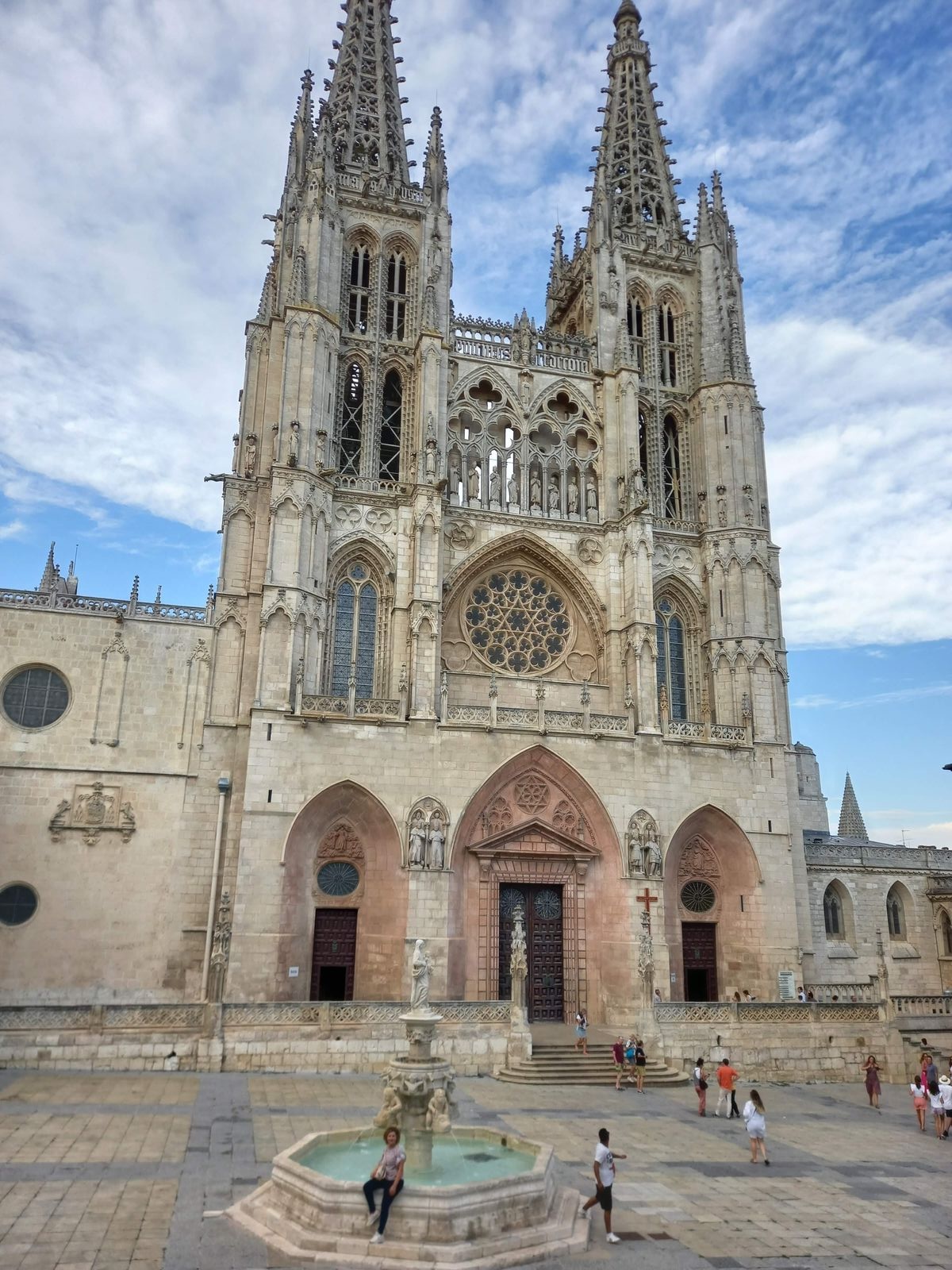
Burgos Cathedral (UNESCO 316)
Cultural World Heritage in Spain, inscribed in 1984
The Burgos Cathedral is located in the historical centre of the Spanish city of the same name, in the Autonomous Community of Castilla y León, in the northern Iberian Peninsula. The inscribed property encompasses 1.03 ha. Construction on the Cathedral began in 1221 and was completed in 1567. It is a comprehensive example of the evolution of Gothic style, with the entire history of Gothic art exhibited in its superb architecture and unique collection of art, including paintings, choir stalls, reredos, tombs, and stained-glass windows.
The plan of the Cathedral is based on a Latin Cross of harmonious proportions of 84 by 59 metres. The three-story elevation, the vaulting, and the tracery of the windows are closely related to contemporary models of the north of France. The portals of the transept (the Puerta del Sarmental to the south and the Puerta de la Coronería to the north) may also be compared to the great sculpted ensembles of the French royal domain, while the enamelled, brass tomb of Bishop Mauricio resembles the so-called Limoges goldsmith work. Undertaken after the Cathedral, the two-storied cloister, which was completed towards 1280, still fits within the framework of the French high Gothic.
After a hiatus of nearly 200 years, work resumed on the Burgos Cathedral towards the middle of the 15th century and continued for more than 100 years. The work done during this time consisted of embellishments of great splendour, assuring the Cathedral’s continued world-renown status. The workshop was composed of an international team, and among the most famous architects were Juan de Colonia, soon relieved by his son Simon (responsible for the towers and open spires of the facade, the Constable's chapel, and the Saint Anne's chapel) and Felipe de Borgoña, assisted by numerous collaborators (responsible for the choir, cupola, and lantern tower over the transept crossing). When two of these architects, Juan de Vallejo and Juan de Castañeda, completed the prodigious cupola with its starred vaulting in 1567, the Burgos Cathedral unified one of the greatest known concentrations of late Gothic masterpieces: the Puerta de la Pellejería (1516) of Francisco de Colonia, the ornamental grill and choir stalls, the grill of the chapel of the Presentation (1519), the retable of Gil de Siloe in the Constable's chapel, the retable of Gil de Siloe and Diego de la Cruz in Saint Anne's chapel, the staircase of Diego de Siloe in the north transept arm (1519), the tombs of Bishop Alonso de Cartagena, Bishop Alonso Luis Osorio de Acuña, the Abbot Juan Ortega de Velasco, the Constable Pedro Hernández de Velasco and, his wife Doña Mencía de Mendoza, etc.
Thereafter, the cathedral continued to be a monument favoured by the arts: the Renaissance retable of the Capilla Mayor by Rodrigo and Martin de la Haya, Domingo de Berriz, and Juan de Anchieta (1562-1580), the tomb of Enrique de Peralta y Cardenas in the chapel of Saint Mary, the chapel of Santa Tecla, and the "trascoro" of the 18th century.