Canterbury Cathedral, St Augustine's Abbey, and St Martin's Church (UNESCO 496)
Cultural World Heritage in United Kingdom of Great Britain and Northern Ireland, inscribed in 1988
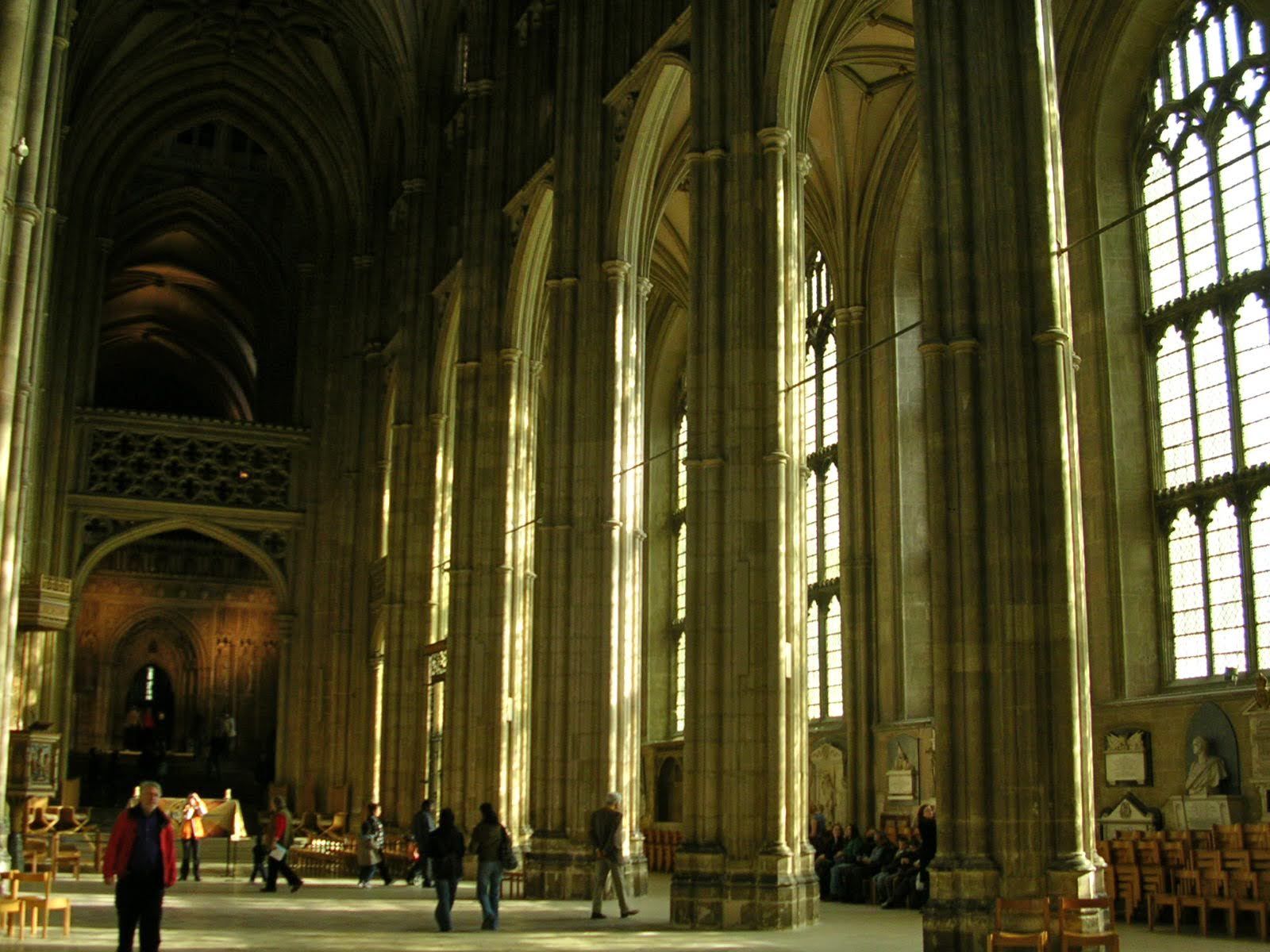
Christ Church Cathedral Canterbury in Kent, South East England, a breath-taking mixture of Romanesque and Gothic architecture, has been the seat of the spiritual head of the Church of England for nearly five centuries. Following the murder of Archbishop Thomas Becket in 1170 AD and his subsequent canonisation it became a place of pilgrimage. St Martin’s church and the ruins of St Augustine’s Abbey form the other main elements of the Property. St Martin’s Church, the ruins of St Augustine’s Abbey and Christ Church Cathedral together reflect milestones in the history of Christianity in Britain.
They reflect in tangible form the reintroduction of Christianity to southern Britain by St Augustine, commencing at St Martin’s Church where Queen Bertha already worshipped, and leading to the conversion of King Ethelbert. They also reflect the successive architectural responses to Canterbury’s developing role as focus of the Church in England – adaptation of Roman buildings, the development of Anglo-Saxon building in mortared brick and stone, and the flowering of Romanesque and Gothic styles in addition to the development under St Augustine and the monks from Rome, of early Benedictine monasticism, which spread from its cradle in Canterbury throughout Britain, had a profound impact on English society. The Abbey scriptorium was one of the great centres of insular book production, and its influence extended far beyond the boundaries of Kent and Northumbria. The development of literacy, education and scholarship at the Abbey meant that Canterbury became the most important centre of learning in the country and Canterbury’s importance as a pilgrimage centre, based on Augustine and its other early saints, was transformed by the murder and canonisation of Archbishop Thomas Becket, whose Cathedral shrine attracted pilgrims from all over Europe and Canterbury became the seat of the spiritual leader of the Church of England.
The wealth and power of the Cathedral in the 12th century resulting from the offerings of large numbers of pilgrims helped the building of the magnificent enlargement of the east end, with its exceptional stained glass windows and the rebuilding of the choir and transepts following the fire of 1174. These features form one of the finest examples of Early Gothic art and the Cathedral’s rich panorama of Romanesque, early Gothic and late Gothic art and architecture is exceptional.