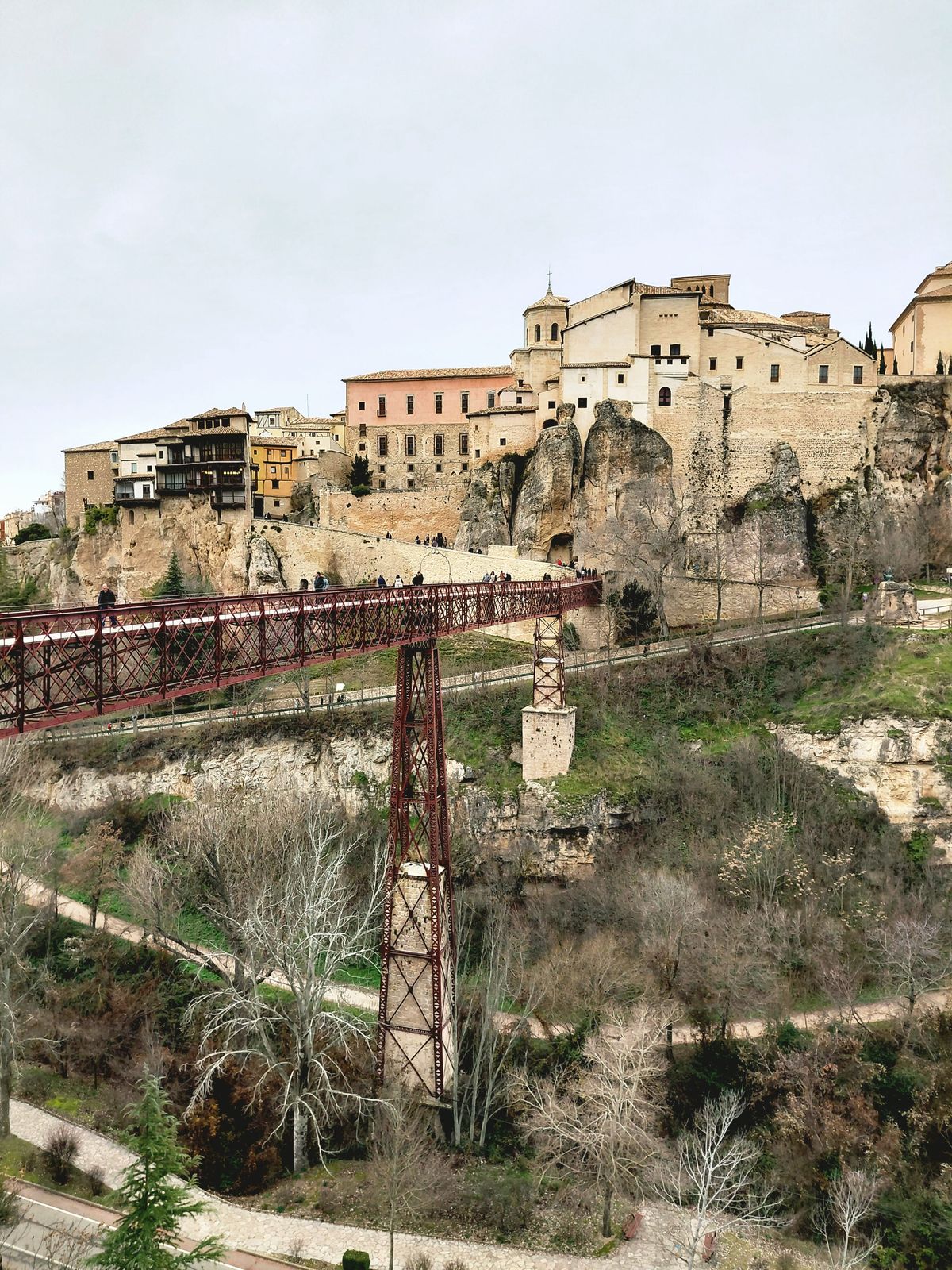
Historic Walled Town of Cuenca (UNESCO 781)
Cultural World Heritage in Spain, inscribed in 1996
Cuenca is a municipality located in central Spain, 170 km south-east of Madrid. The historic walled town stretches over 23 hectares, with an important monumental heritage and a consolidated cultural tradition. Built by the Islamic rulers in a defensive position at the outer fringes of the Caliphate of Córdoba, Cuenca is an unusually well-preserved medieval fortified city. The site is dominated by the upper town, developed on the site of Islamic fortress after its conquest by the Castilians in the 12th century.
It then became a royal town and bishopric endowed with important buildings. This is the archetype of the fortress-town, and the part that gives Cuenca its individual character. The “Castillo” quarter is a small suburb just outside the walls, with some remains of the Islamic fortress. Within the upper town there is a wealth of historic religious buildings from the medieval, renaissance, and Baroque periods, notably the 12th century cathedral, built on the site of the former Great Mosque and the first Gothic cathedral in Spain.
Taking full advantage of its location, the city towers rise above the magnificent countryside. No account of the upper town is complete without references to the so-called “Hanging Houses” (casas colgadas). These private houses near the Episcopal Palace were built in the later medieval period on the spectacular steep bluffs overlooking the bend of the Huecar river. Most of them were rebuilt in the 16th century in their present narrow, high form, with two or three rooms on each of three or more floors.
The historic quarter of Cuenca is an outstanding example of the medieval fortress-town. Other examples exist in Spain (Toledo) and in Italy (Urbino, Orvieto) and France (Carcassonne). The special qualities of Cuenca relate to the intact nature of its townscape, as a result of a long period of economic stagnation and social deprivation, and to its dramatic contribution to the natural landscape. The Old Town of Cuenca has preserved its original townscape remarkably intact along with many excellent examples of religious and secular architecture from the 12th to 18th centuries.
It is also exceptional because the walled town blends into and enhances the fine rural and natural landscape in which it is situated.
The Committee decided to inscribe the nominated property on the basis of cultural criteria (ii) and (v) considering that the site is of outstanding universal value as it is an exceptional example of the medieval fortress town that has preserved its original townscape remarkably intact along with many excellent examples of religious and secular architecture from the 12th to the 18th centuries. It is also exceptional because the walled town blends into and enhances the fine rural and natural landscape within which it is situated.