Mudejar Architecture of Aragon (UNESCO 378)
Cultural World Heritage in Spain, inscribed in 1986
The development in the 12th century of Mudéjar art in Aragon resulted from the particular political, social, and cultural conditions that prevailed in Spain after the Reconquista. Geographically, Aragonese Mudéjar art can be found mainly along the Ebro river valley and its southern tributaries in the northeast Iberian Peninsula. From a historical point of view, this artistic genre belongs to a lengthy period that lasted from the 12th to the 17th century. Mudéjar art is an artistic phenomenon that does not belong entirely to the cultures of Western Europe or Islam.
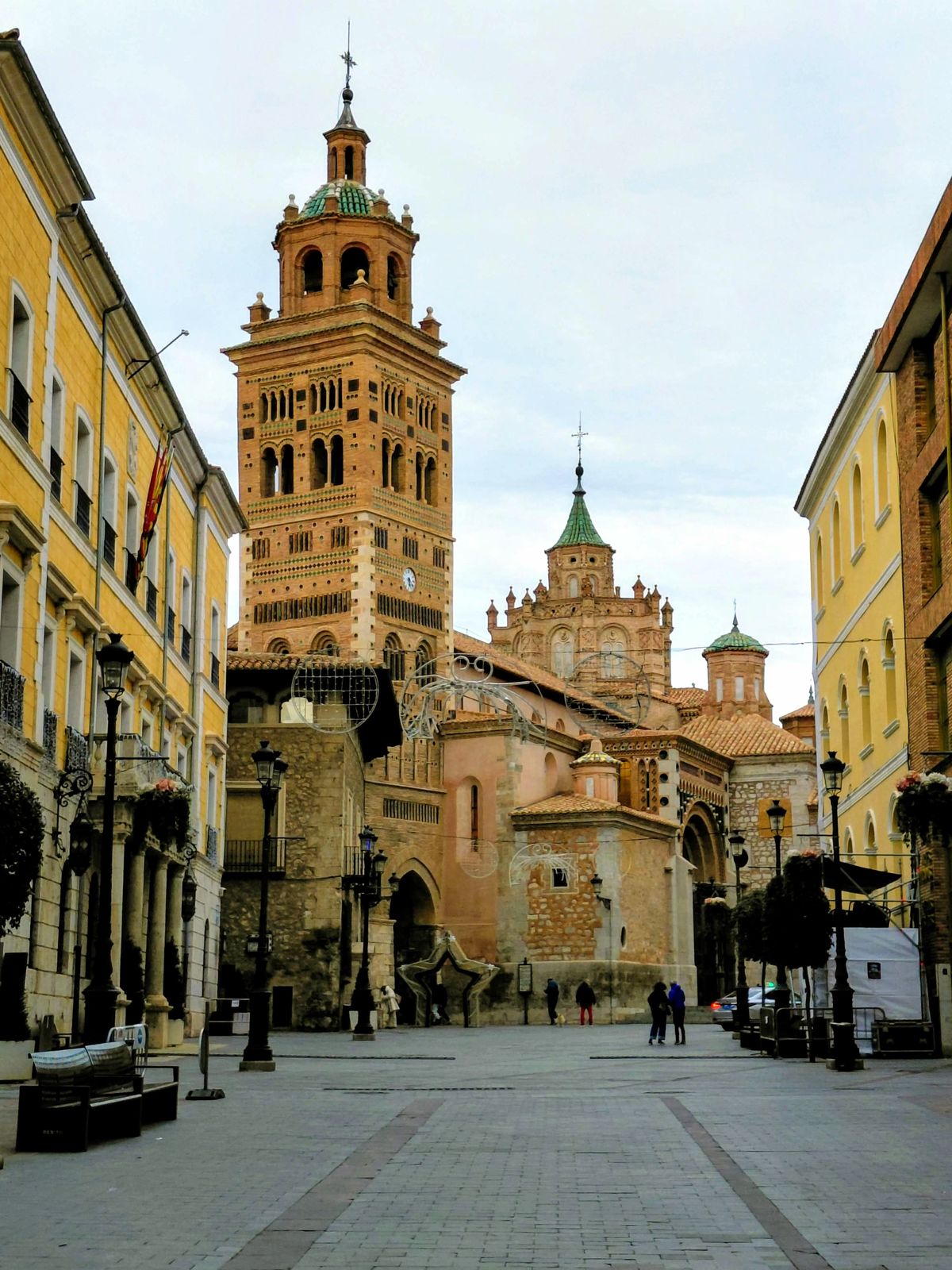
Rather, it constitutes an authentic testament to the peaceful co-existence in medieval Spain of Christianity and Islam with contributions from Jewish culture, the fruit of which was a new form of artistic expression. This art, influenced by Islamic tradition, also reflects various contemporary European styles, particularly the Gothic. The property comprises ten religious and secular monuments in the provinces of Teruel and Zaragoza. They include: the tower, roof, and cimborio of the Cathedral of Santa María de Mediavilla de Teruel; the tower and church of San Pedro de Teruel; the church tower of San Martín de Teruel; the church tower of Salvador de Teruel; the apse, cloister, and tower of the collegiate church of Santa María de Calatayud; the parish church of Santa Tecla de Cervera de la Cañada; the church of Santa María de Tobed; the surviving Mudéjar features of the Aljafería Palace of Zaragoza; the tower and parish church of San Pablo de Zaragoza; and the apse, parroquieta, and cimborio of la Seo de Zaragoza.
The Mudéjar architecture of Aragon is, on account of the formal solutions adopted and the techniques and materials of construction employed, a specific and extraordinary legacy, as well as a vivid reflection of a moment in history when three cultures with very different roots flourished together on Aragonese soil. Decorative motifs from a great variety of traditions can be seen in the ten monuments that make up this property including: Greco-Roman, Byzantine, Sassanid, Seljuq, Berber, and Visigoth among others. Thus, we can identify in these Aragonese monuments the rhombus-shaped mouldings (sebqa), stars, angled and interlaced brick friezes, arrows, lobed and multi-grooved arches, as well as elements of construction characteristic of Islamic art such as alfiz panels, decorated eaves (rafes), and lattice work. Other structures employed include Almohade-style minarets for the belltowers, collar beam roofs, and Moamar-style carved ceilings to cover various spaces.
The materials employed, which are very varied in Aragon, were typical of Islamic art. These include brick, ceramics, plaster, and wood; all materials that are generally not very durable over time. Such materials were used as to follow the Islamic philosophy that everything is transitory and impermanent but for Allah, the only being that exists eternally. The ten inscribed component parts are the most representative and reflect best this particular historic and cultural phenomenon, symbolising pacific cultural coexistence and the exchange of knowledge and experiences.
Undoubtedly, the monuments that make up this historical legacy are silent witnesses to a a key moment in the history of Spain, in which its inhabitants, despite their different beliefs, were able to live side by side in peace.